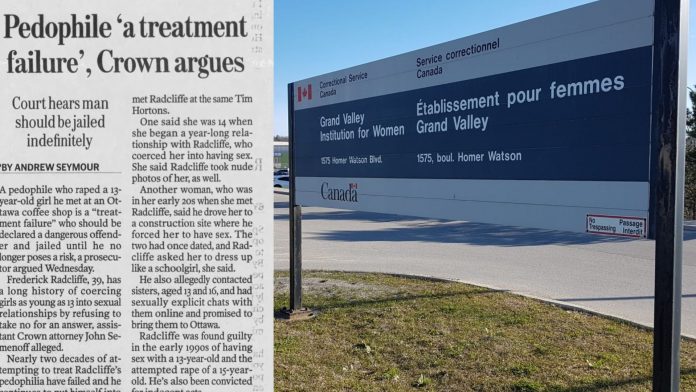
Frederick Radcliffe: The Dangerous Offender Who Raped Children and Was Transferred to a Women's Prison

GIVEN NAME:
Frederick Radcliffe
ALIAS:
Carissa Marie Radcliffe
DATE:
2009 (conviction); 2023 (transfer and subsequent assaults at GVI)
LOCATION:
Grand Valley Institution for Women, Kitchener, Ontario
Frederick Radcliffe has been convicted of sexual offences against females — including the rape of a thirteen-year-old girl — across four separate criminal proceedings spanning 1989 to 2009, earning a Dangerous Offender designation and indeterminate sentence in 2010. After identifying as transgender in 2017 and undergoing a taxpayer-funded vaginoplasty, he was transferred to Grand Valley Institution for Women in 2023, where two female inmates subsequently filed official sexual assault reports against him.
Full Story
In early 2023, a man with one of the most disturbing sexual offence histories in this database was transferred from a men's federal prison to the Grand Valley Institution for Women in Kitchener, Ontario.
Frederick Radcliffe — who now goes by Carissa Marie Radcliffe — had been raping and sexually assaulting women and children since at least 1989. He had been convicted of sexual offences against females across four separate criminal proceedings. He had been designated a Dangerous Offender in 2010 — one of the rarest and most serious sentencing designations in Canadian law, reserved for individuals deemed to pose a continuing threat to public safety with no foreseeable timeline for rehabilitation. He was serving an indeterminate sentence, meaning he could not be released until the Parole Board of Canada determined he was no longer a risk.
In 2017, Radcliffe's appeal of his conviction and sentence was dismissed. It was around this time that he began identifying as transgender and changed his name to Carissa Marie.
By early 2023, after undergoing a taxpayer-funded vaginoplasty, Radcliffe had been transferred to Grand Valley Institution for Women — a campus-style facility in Kitchener that houses female federal inmates, including survivors of male violence.
By October of that year, he had been relocated to a maximum security unit within the institution after two female inmates filed official reports alleging he had sexually assaulted them.
The Correctional Service of Canada has not publicly commented on the investigation.
A Criminal History That Spanned Decades
Early Offences: 1989 to 1992
Radcliffe's criminal record for sexual offences dates to at least 1989. Court records document a pattern that began with indecent exposure and escalated steadily to rape.
Between 1989 and 1990, Radcliffe was convicted of multiple indecent acts involving exposing his penis to female victims while masturbating in their presence. At least one of those victims was fifteen years old.
In 1991, he was convicted of sexual assault against a nineteen-year-old female victim.
In 1992, he was convicted of sexual interference — a charge that applies to sexual touching of a person under the age of fourteen — against a thirteen-year-old victim.
These convictions established a clear pattern within the first three years of his recorded offending: Radcliffe targeted females of all ages, from children to adults, and his offending escalated in severity from exposure to contact sexual assault to sexual interference of a minor.
Throughout this period and in subsequent years, Radcliffe also accumulated convictions for non-sexual offences including theft, criminal harassment, and criminal misconduct — a record suggesting a broader pattern of predatory and antisocial behaviour that extended beyond sexual offending.
The 2007 Rape of a Thirteen-Year-Old Girl
The offence that led to Radcliffe's Dangerous Offender designation and indeterminate sentence occurred in 2007 in Ottawa.
Radcliffe encountered a thirteen-year-old girl at a Tim Hortons on Donald Street. He offered her a ride home. She accepted.
Instead of taking her home, Radcliffe drove to a location behind a car wash and raped her.
In 2009, Radcliffe was found guilty of sexual assault and sexual interference of a person under the age of fourteen. The court accepted the evidence that Radcliffe had specifically targeted a child, created a scenario of apparent safety and trust to gain access to her, and then committed a violent sexual assault when she was isolated and unable to escape.
Dangerous Offender Designation — 2010
In 2010, Frederick Radcliffe was designated a Dangerous Offender by a Canadian court — one of the most serious sentencing designations available under the Criminal Code.
The Dangerous Offender designation is applied only where the court is satisfied that the pattern of behaviour underlying the offences demonstrates a failure to restrain violent or sexual impulses, and that the offender presents a threat of death or severe physical injury or severe psychological damage to other members of the public. The designation carries an indeterminate sentence: the offender is imprisoned indefinitely and can only be released when the Parole Board of Canada determines, on the basis of evidence, that he is no longer a risk to public safety.
The Ottawa Sun, in reporting on related cases, described Radcliffe as a "pedophile with psychopathic traits." Court documents from his proceedings noted that Radcliffe had taken Viagra while on libido-suppressing medication — a pharmaceutical intervention that courts sometimes require for sex offenders — specifically to circumvent the medication's intended effect. His conduct in circumventing a court-sanctioned risk management tool demonstrated both his ongoing sexual preoccupation and his willingness to deliberately undermine the safeguards placed on him.
Upon his eventual release — if and when the Parole Board permits it — Radcliffe will be placed on the sex offender registry and prohibited from entering public parks and public swimming areas where persons under the age of fourteen may be present for a minimum of ten years.
The 2017 Appeal and the Transgender Identification
In 2017, Radcliffe applied to appeal both his 2009 conviction and his 2010 indeterminate sentence. The court dismissed both appeals.
It was around this time that Radcliffe began identifying as transgender. He changed his name to Carissa Marie and began presenting as a woman. No existing court records from any of his proceedings make any reference to gender identity issues or gender dysphoria. All historical media coverage of his offences and criminal proceedings refers to him as male. There is no documented history of Radcliffe experiencing or claiming gender identity concerns prior to the dismissal of his 2017 appeals.
The timing — a transgender identification following the failure of legal appeals and in the context of an indeterminate sentence with no fixed release date — is consistent with a pattern documented in multiple other entries in this database: a male sex offender adopting a transgender identity after exhausting other legal avenues, with no prior history of gender identity concerns.
Transfer to Grand Valley Institution for Women
The Transfer Decision
Radcliffe underwent a vaginoplasty — a surgical procedure that removes male genitalia and constructs female genitalia — as part of his gender transition. This procedure was funded by the Canadian federal corrections system, as gender-affirming surgery for federal inmates is considered medically necessary care under Canadian correctional policy.
The surgical transition was the basis for Radcliffe's transfer from Bath Institution — a medium-security federal facility for male inmates in Ontario — to Grand Valley Institution for Women in Kitchener, Ontario. The transfer occurred in early 2023.
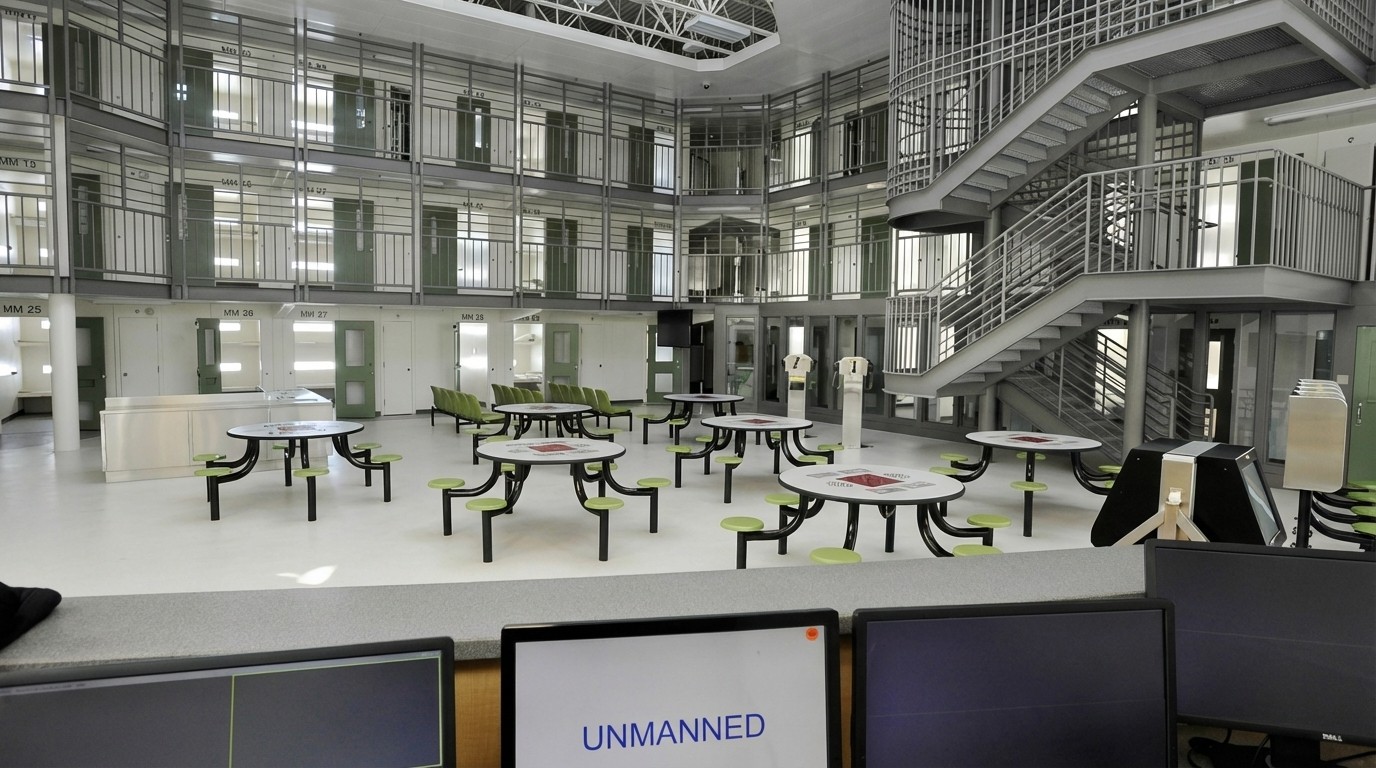
Grand Valley Institution for Women is Canada's largest federal women's prison. It is a campus-style facility with multiple residential houses where inmates live together in a relatively open setting, by federal corrections standards. It houses women convicted of a wide range of offences, many of whom have histories of trauma and victimization by males.
The transfer was first brought to public attention on March 7, 2023, by Heather Mason — a former federal prisoner at Grand Valley, caWsbar board member, and advocate for incarcerated women — who posted about Radcliffe's presence at the facility on social media.
The Institutional Environment
Grand Valley's campus design means that inmates live in close proximity in residential units. Unlike higher-security facilities where inmates are more individually confined, Grand Valley's setting involves shared living spaces, communal meals, and regular contact between inmates in the same housing unit.
Radcliffe was placed in one of these housing units. He was, by the accounts of female inmates who subsequently reported to Reduxx and other outlets, present in the day-to-day living environment of women who had been placed in a federal women's prison precisely because sex-separation was considered necessary for their safety and dignity.
The Assault Reports and Investigation
By October 4, 2023 — approximately nine months after Radcliffe's arrival at Grand Valley — CSC relocated him to a maximum security unit within the institution. This removal from general housing followed the filing of official assault reports by female inmates.
According to reporting by Reduxx, which broke the investigation story in February 2025, two women had filed official reports with CSC alleging that Radcliffe had forcefully sexually attacked them.
One of the victims, speaking to Reduxx using the pseudonym Emma to protect her identity, asked: "Why has the Correctional Service of Canada placed me in this housing situation with Radcliffe, knowing how vulnerable I am as a survivor of sexual abuse that already occurred here in GVI?"
Emma's question carries a specific and devastating weight: she had previously been sexually assaulted by another trans-identified male inmate at Grand Valley. She was, according to her own account, a documented survivor of male-perpetrated sexual assault within the institution — and CSC had placed her in a housing situation with a Dangerous Offender who had a multi-decade history of sexual violence against women and girls.
"Why don't my rights matter?" Emma asked.
CSC has not publicly responded to the specific allegations, consistent with its practice of citing privacy protections to avoid comment on individual inmates. The investigation status as of early 2025 has not been publicly resolved.
The Pattern This Case Illustrates
Dangerous Offenders in Women's Prisons
The Dangerous Offender designation exists because the criminal justice system recognizes that some individuals cannot be safely managed in the community or in standard corrections settings. The designation is rare — applied only after extensive psychiatric and legal assessment — and it carries the most severe incapacitation measure available in Canadian law: indefinite imprisonment with no guaranteed release.
The transfer of a Dangerous Offender to a women's institution raises a question that Commissioner's Directive 100 does not address: when an individual has been assessed as posing a continuing threat of severe physical injury or severe psychological damage to members of the public, does that risk assessment change because the individual identifies as a different gender?
The answer, in the Radcliffe case, appears to be no. The pattern of sexual offending that led to the Dangerous Offender designation — targeting females across a range of ages, in positions of vulnerability, with escalating severity — is a pattern directed at female victims. Transferring Radcliffe to an institution housing exclusively female inmates did not reduce his access to potential victims. It increased it.
The Timing of Transgender Identification
No court record, psychiatric assessment, or media coverage from any of Radcliffe's criminal proceedings — spanning nearly three decades — makes any reference to gender identity concerns. He is described throughout as male. His sexual offending was documented as heterosexual and predatory across multiple victim ages.
His transgender identification emerged at the same time as the failure of his 2017 legal appeals — at the moment when the realistic prospect of release from an indeterminate sentence became most remote. The surgical vaginoplasty that followed, funded by the corrections system, then became the basis for his transfer to a women's institution.
This sequence — indeterminate sentence, failed appeals, transgender identification, surgery, transfer to women's prison — is not unique to Radcliffe in this database. It is a documented pattern that raises legitimate questions about the relationship between gender identity claims and the strategic management of incarceration conditions by male sex offenders.
CSC's Accountability
Correctional Service Canada was aware, when it transferred Radcliffe to Grand Valley, of his complete criminal history. It was aware of his Dangerous Offender designation. It was aware of the indeterminate nature of his sentence and the basis for it. It was aware that he had targeted female victims across his entire offending career.
CSC transferred him anyway, to an institution housing exclusively the demographic he had spent his criminal career victimizing.
When the predictable occurred — when two women at that institution filed official assault reports — CSC's response was to move Radcliffe to a different unit within the same facility. Not to return him to a men's institution. Not to reassess whether the transfer had been appropriate. To move him within Grand Valley.
The women who were assaulted remain in the federal corrections system. Their assaults — if substantiated — will be recorded in CSC's data. Whether they will be recorded accurately — distinguishing a male perpetrator from the female population — depends on how CSC and Statistics Canada handle the recording of sex for trans-identified inmates in crime data. As documented in the Statistics Act entry in this series, there is reason to believe they will not be.
Conclusion
Frederick Radcliffe has been raping and sexually assaulting women and girls for at least thirty-five years. He was designated a Dangerous Offender because the court found, after extensive assessment, that he could not be safely managed and posed a continuing threat of severe harm to members of the public.
After his legal appeals failed, he identified as transgender. After identifying as transgender, he underwent surgery. After surgery, he was transferred to a women's federal prison.
Within approximately nine months, two women in that prison had filed official assault reports against him.
The question Correctional Service Canada has not answered — and has not been publicly required to answer — is what assessment it conducted before transferring a multi-conviction sex predator with a Dangerous Offender designation into an institution housing exclusively female inmates. What risk assessment said this was safe? What process considered the impact on the women who would be housed with him? Who made the decision, and on what basis?
These questions have not been answered. The investigation into the assaults at Grand Valley has not been publicly resolved. And Radcliffe remains in the federal corrections system, in an institution designed to house women.
Timeline
1989–1990: Convicted of multiple indecent acts — exposing himself and masturbating in front of female victims, including a fifteen-year-old girl
1991: Convicted of sexual assault against a nineteen-year-old female victim
1992: Convicted of sexual interference against a thirteen-year-old female victim
1989–2006: Accumulated additional convictions for theft, criminal harassment, and criminal misconduct
2007: Encountered a thirteen-year-old girl at a Tim Hortons on Donald Street, Ottawa; offered her a ride home; drove her behind a car wash and raped her
2009: Convicted of sexual assault and sexual interference of a person under the age of fourteen
2010: Designated a Dangerous Offender by the court; handed an indeterminate sentence; described in the Ottawa Sun as a "pedophile with psychopathic traits"; documented to have taken Viagra while on court-ordered libido-suppressing medication to circumvent its effects
2017: Appeals of conviction and sentence dismissed; began identifying as transgender woman "Carissa Marie Radcliffe"; no prior history of gender identity concerns in any court documents
Post-2017: Underwent taxpayer-funded vaginoplasty as part of gender transition
Early 2023: Transferred from Bath Institution (men's medium security, Ontario) to Grand Valley Institution for Women, Kitchener, Ontario
March 7, 2023: Heather Mason publicly raised alarm about Radcliffe's presence at Grand Valley on social media
October 4, 2023: Relocated to maximum security unit within Grand Valley after two female inmates filed official assault reports alleging Radcliffe had sexually attacked them
February 2025: Reduxx publishes exclusive investigation into assault allegations; victim using pseudonym "Emma" — a survivor of a prior assault by another trans-identified male at the same institution — asks: "Why don't my rights matter?"
Ongoing: CSC investigation status not publicly resolved; Radcliffe remains in the federal corrections system
References
Reduxx (March 21, 2023). "CANADA: 'Dangerous' Male Pedophile Transferred To Women's Prison." https://reduxx.info/canada-dangerous-male-pedophile-transferred-to-womens-prison/
Reduxx (February 25, 2025). "EXCLUSIVE: 'Dangerous' Trans-Identified Male Pedophile Under Investigation For Sexually Assaulting Female Inmates In Canadian Women's Prison." https://reduxx.info/exclusive-dangerous-trans-identified-male-pedophile-under-investigation-for-sexually-assaulting-female-inmates-in-canadian-womens-prison/
The Post Millennial (March 8, 2023). "Biological male pedophile who raped 13-year-old girl transferred to Ontario women's prison." https://thepostmillennial.com/biological-male-pedophile-who-raped-13-year-old-girl-transferred-to-ontario-womens-prison
Ottawa Sun, coverage of Radcliffe criminal proceedings (multiple dates). Description: "pedophile with psychopathic traits."
CTV Ottawa, reporting on 2009 conviction of Frederick Radcliffe for sexual assault and sexual interference of a thirteen-year-old in Ottawa.
Mason, Heather (March 7, 2023). Twitter/X post first alerting public to Radcliffe's transfer to Grand Valley Institution for Women. @Mason134211f.
Mason, Heather (June 22, 2021). "Brief to The Standing Committee on Public Safety and National Security." https://www.ourcommons.ca/Content/Committee/432/SECU/Brief/BR11468302/br-external/MasonHeather-e.pdf
Criminal Code, RSC 1985, c C-46, s 753 (Dangerous Offender designation): https://laws-lois.justice.gc.ca/eng/acts/c-46/
Correctional Service Canada, Commissioner's Directive 100: Gender Diverse Offenders (in effect May 9, 2022): https://www.canada.ca/en/correctional-service/corporate/acts-regulations-policy/commissioners-directives/100.html
Canadian Women's Sex-Based Rights (caWsbar): https://cawsbar.ca/

text
Dereck Sears: The Man Who Identified as a Woman Days Before Murder, Then Used the Charter to Try to Change His Name on the Indictment
Dereck Donald Sears murdered Darren Middleton, 49, at his Kelowna residence on June 16, 2021 — bludgeoning him with a baseball bat, stabbing him multiple times, partially severing his penis, and removing and consuming his testicles while claiming to follow "telepathic instructions from a child ghost." Sears had identified as a woman to Middleton and his partner just days before the killing, and is now pursuing a not criminally responsible defence while simultaneously seeking to have his name changed from Dereck to Gabriella on his murder indictment — a novel application his Crown prosecutor described as unprecedented in Canadian criminal law.

text
Heather Mason: The Former Prisoner Who Refused to Stay Silent — And What She Found When She Started Asking
Heather Mason is a former federal prisoner at Grand Valley Institution for Women, a founding member of caWsbar, and the primary whistleblower who documented the harms of CSC's gender-diverse offender transfer policy through a 2021 parliamentary brief, a national survey of incarcerated women, organized protests at five federal women's institutions, and a 2026 affidavit supporting the caWsbar Charter challenge — providing Parliament and the public with the first systematic, sourced account of sexual assault, physical violence, harassment, and institutional betrayal inside Canada's federal women's prisons.