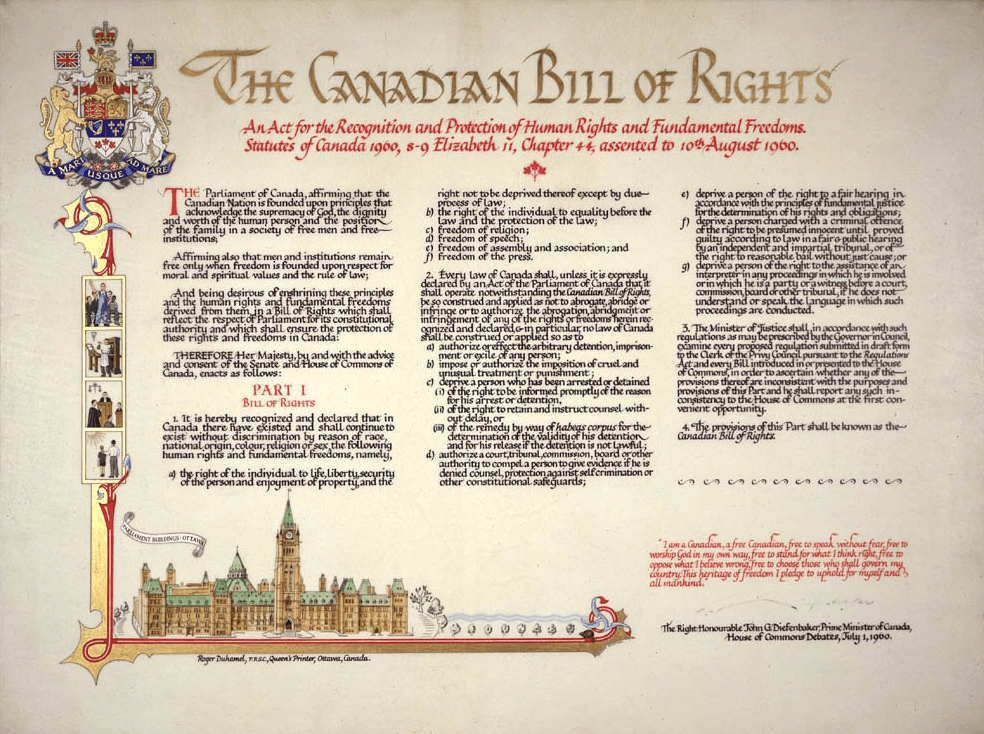
Canadian Bill of Rights, S.C. 1960, c. 44
Canada's first federal human rights statute, enacted in 1960 under Prime Minister Diefenbaker; protects equality before the law without discrimination by sex — and is directly named in caWsbar's Charter challenge as violated by CSC's prison placement policy, making it an active legal instrument, not merely a historical one.
The Canadian Bill of Rights: When 'Sex' Meant Something Clear
In August 1960, Prime Minister John Diefenbaker introduced Canada's first federal human rights statute into law. The Canadian Bill of Rights was modest by the standards of what would follow — it applied only to federal jurisdiction, it was an ordinary statute rather than a constitutional document, and it would eventually be eclipsed in practical importance by the Canadian Charter of Rights and Freedoms in 1982. But it did one thing that matters enormously to the current legal fight over incarcerated women's rights: it declared, clearly and without qualification, that every person in Canada has the right to equality before the law without discrimination by reason of sex.
In 1960, no one debated what "sex" meant in that declaration. It meant biological sex — the distinction between male and female persons that Canadian law had recognized since Confederation. The Canadian Bill of Rights protected female persons from being treated unequally because they were female. It said so plainly. And it has said so continuously, without amendment, for sixty-five years.
That plain declaration is now directly relevant to the legal challenge caWsbar launched on April 7, 2025. The lawsuit filed by the Justice Centre for Constitutional Freedoms and Charter Advocates Canada on caWsbar's behalf does not rely solely on the Canadian Charter of Rights and Freedoms. It also names violations of sections 1(a), 1(b), and 2(b) of the Canadian Bill of Rights — the 1960 statute that established sex-based equality in federal law more than two decades before the Charter existed.
The Canadian Bill of Rights is not a historical curiosity. It is an active legal instrument. And in the fight for incarcerated women's rights, it matters.
What the Canadian Bill of Rights Is
The Canadian Bill of Rights was the product of John Diefenbaker's longstanding personal commitment to a written statement of individual rights in Canadian law. Diefenbaker had championed the idea since the 1940s, and when his Progressive Conservative government came to power in 1957 with a large majority, he had both the mandate and the political capital to act.
The Bill was passed as ordinary federal legislation — not as a constitutional amendment — because the provinces could not agree on constitutional reform. This limited its scope: unlike the Charter, which is entrenched in the Constitution and applies to all levels of government, the Bill of Rights applies only to federal laws and to actions taken under federal authority. Provincial laws and provincial institutions are outside its reach.
Within its federal scope, however, the Bill of Rights declared a comprehensive set of individual rights and freedoms that federal law was not to abrogate, abridge, or infringe. Section 1 recognized and declared the existence of these rights. Section 2 provided that no federal law shall be construed or applied in a way that would violate them.
The rights declared in Section 1 include:
The right of the individual to life, liberty, security of the person, and enjoyment of property, and the right not to be deprived thereof except by due process of law — Section 1(a).
The right of the individual to equality before the law and the protection of the law without discrimination by reason of race, national origin, colour, religion, or sex — Section 1(b).
Freedom of religion, freedom of speech, freedom of assembly and association, and freedom of the press — Sections 1(c) through 1(f).
These rights were declared to exist in Canada and were placed beyond the reach of ordinary federal legislation — within the limits of what an ordinary statute could accomplish without constitutional entrenchment.
Why "Sex" in 1960 Matters in 2025
The Canadian Bill of Rights has protected sex-based equality in federal law since 1960. That is not a minor historical footnote. It is a sixty-five-year legislative record establishing that biological sex is a protected characteristic in federal law — a record that predates the Charter, predates Bill C-16, and predates every administrative policy that has eroded sex-based protections for women in federal institutions.
When Bill C-16 was passed in 2017, adding "gender identity or expression" to the Canadian Human Rights Act and Criminal Code, Parliament did not amend the Canadian Bill of Rights. The Bill of Rights still protects equality before the law without discrimination by reason of sex — biological sex, as it was understood in 1960 and as it has been understood throughout the Bill's history.
This matters for the legal challenge in a specific way. CSC's Commissioner's Directive 100 places male-bodied inmates in women's federal institutions. To the extent that this policy is authorized by or flows from federal law — including the Canadian Human Rights Act as amended by Bill C-16 — Section 2(b) of the Canadian Bill of Rights provides that those federal laws cannot be construed or applied so as to abrogate, abridge, or infringe the right to sex-based equality declared in Section 1(b).
Put plainly: federal law cannot be used to eliminate sex-based protections for women. The Canadian Bill of Rights has said so since 1960. CSC's placement policy, which eliminates sex-based protections for incarcerated women in the name of gender identity accommodation, is precisely the kind of abridgement of sex-based equality rights that Section 2(b) was designed to prevent.
The Diefenbaker Vision and What It Protected
John Diefenbaker's vision for the Canadian Bill of Rights was explicitly grounded in the equal dignity of every individual regardless of personal characteristics they did not choose. He was animated by the experience of the Second World War — by the recognition that systematic discrimination against groups defined by race, religion, or national origin had produced the worst atrocities in human history — and by his conviction that Canadian law should declare unambiguously that such discrimination had no place in a free society.
When Diefenbaker included sex in the list of prohibited grounds of discrimination, he was recognizing that women — like members of racial and religious minorities — were a group that had historically been subjected to discrimination on the basis of a characteristic they did not choose and could not change. The protection was grounded in biological reality: women were discriminated against because they were biologically female. The law declared that this discrimination was incompatible with equality before the law.
The meaning of "sex" in that declaration was biological. It could not have been otherwise in 1960, and it has not been amended to mean anything else since. The Canadian Bill of Rights protects biological women from discrimination because they are biological women — and it does so under federal law that has been continuously in force for sixty-five years.
Section 2(b): The Interpretive Shield
Section 2(b) of the Canadian Bill of Rights provides: "Every law of Canada shall, unless it is expressly declared by an Act of the Parliament of Canada that it shall operate notwithstanding the Canadian Bill of Rights, be so construed and applied as not to abrogate, abridge or infringe or to authorize the abrogation, abridgement or infringement of any of the rights or freedoms herein recognized and declared."
This provision is sometimes described as a construction rule — a directive to courts about how to interpret federal legislation. But it is more than a rule of statutory interpretation. It is a declaration that federal law, to the extent it can be read consistently with the rights in Section 1, must be read that way — and that to the extent it cannot, the rights take priority.
Applied to the current legal challenge, Section 2(b) has a specific and powerful implication. CSC's placement policy is grounded in an interpretation of the Canadian Human Rights Act — specifically, the interpretation that adding "gender identity or expression" as a protected ground requires accommodation through cross-sex placement in federal prisons. But the Canadian Human Rights Act is a law of Canada subject to Section 2(b). If that interpretation would abrogate, abridge, or infringe the right to sex-based equality recognized in Section 1(b), then federal law must not be construed or applied in that way.
The Canadian Bill of Rights, in other words, provides a legal basis for arguing that CSC's interpretation of the Canadian Human Rights Act is itself unlawful — that it cannot be the correct interpretation of federal law because the correct interpretation must be consistent with sex-based equality rights that have been protected in federal law since 1960.
This is one of the arguments advanced in caWsbar's legal challenge. It is grounded in sixty-five years of uninterrupted federal statutory protection for sex-based equality.
The Relationship Between the Bill of Rights and the Charter
The Canadian Charter of Rights and Freedoms, enacted in 1982, is the more powerful instrument. It is constitutionally entrenched, it applies to all levels of government, and its provisions are directly enforceable by courts with broad remedial powers including the ability to strike down legislation. The Charter has largely displaced the Canadian Bill of Rights in legal practice — most rights claims are advanced under the Charter rather than the Bill.
But the Bill of Rights has not been repealed. It remains in force. And in at least two respects it offers advantages that the Charter does not.
The first is scope. The Charter applies broadly to all government action. The Canadian Bill of Rights applies specifically to federal laws. In the context of CSC's placement policy — which is a federal policy implemented by a federal institution under federal legislation — the Bill of Rights' federal scope is precisely calibrated to the legal question at issue.
The second is the absence of Section 1 balancing. The Charter's rights are subject to Section 1 — the government can justify rights violations if they meet the Oakes test of pressing objective, proportionality, and minimal impairment. The Canadian Bill of Rights contains no equivalent provision. A federal law that abridges sex-based equality rights under the Bill of Rights cannot be saved by a demonstration that the abridgement is a reasonable limit. The protection is more absolute within its scope.
This means that if CSC's policy violates Section 1(b) of the Canadian Bill of Rights, the government cannot justify the violation by arguing that gender identity accommodation is a sufficiently important objective to warrant the limitation. The Bill of Rights does not permit that argument. The sex-based equality right it protects is not subject to override by competing policy objectives — at least not without an express parliamentary declaration under the notwithstanding-equivalent provision, which has never been invoked.
The Supreme Court and the Bill of Rights
The Supreme Court of Canada has not often relied on the Canadian Bill of Rights in recent decades — the Charter has provided the primary framework for rights adjudication. But the Court has never held that the Bill of Rights is inoperative or that its protections have been absorbed by the Charter.
In R v Drybones (1970), decided before the Charter existed, the Supreme Court held that the Canadian Bill of Rights could be used to strike down federal legislation that discriminated on the basis of race — establishing that the Bill had real legal force, not merely aspirational effect. That decision has never been overruled.
The Supreme Court's relative silence on the Bill of Rights since the Charter's enactment reflects the Charter's practical superiority as a rights instrument, not any determination that the Bill of Rights has ceased to operate. In a case where the Bill of Rights offers arguments that the Charter does not — particularly on the question of sex-based equality rights against which there is no Section 1 balancing — the Court would be required to engage with those arguments.
caWsbar's legal challenge presents exactly that case. The claims under the Canadian Bill of Rights are not redundant with the Charter claims — they advance arguments about the limits of federal law's authority to abridge sex-based equality that the Charter framework, with its Section 1 balancing, cannot fully capture.
What "Sex" Has Always Meant
The deepest significance of the Canadian Bill of Rights in the current legal fight is historical and definitional. The Bill has protected sex-based equality in Canadian federal law since 1960. Throughout that sixty-five-year history — through the women's liberation movement, through pay equity legislation, through the Charter's enactment, through decades of human rights jurisprudence — "sex" in Canadian federal law has meant biological sex.
It has meant the biological characteristic that distinguishes female persons from male persons. It has meant the characteristic by reason of which women were historically discriminated against — passed over for employment, excluded from professional associations, denied property rights, subjected to legal subordination — and which Canadian law progressively moved to protect.
Bill C-16 did not amend the Canadian Bill of Rights. It did not redefine "sex" in the Bill's Section 1(b). It did not declare that the Bill of Rights would operate notwithstanding its sex-based equality protections. The sex-based equality right that has existed in Canadian federal law since 1960 is unchanged.
What has changed is the federal government's interpretation of what other federal laws require. And it is precisely that interpretation — that federal anti-discrimination law requires accommodating gender identity claims by eliminating sex-based protections for women — that the Canadian Bill of Rights, through Section 2(b), declares cannot be the law.
Federal law must be construed and applied so as not to abrogate sex-based equality rights. CSC's placement policy abrogates those rights. The Canadian Bill of Rights says so — and has said so since the year Diefenbaker put pen to paper.
Conclusion: The Statute That Has Waited Sixty-Five Years
The Canadian Bill of Rights was never the instrument its author hoped it would be. Diefenbaker wanted a constitutional document. He got an ordinary statute. Its practical impact was limited from the beginning by its non-constitutional status, its federal-only scope, and courts' reluctance to use it to strike down legislation. The Charter arrived in 1982 and took centre stage.
But the Bill of Rights never left. It has been quietly protecting sex-based equality in federal law for sixty-five years — waiting, in a sense, for a case in which its specific features matter more than the Charter's broader reach. That case has arrived.
The women incarcerated in Canada's federal prisons have their sex-based equality rights violated every day that male-bodied inmates are housed with them under Commissioner's Directive 100. Those rights are violated by a federal institution implementing a federal policy grounded in federal law. The Canadian Bill of Rights applies to every element of that chain. Its Section 1(b) declares the right. Its Section 2(b) declares that federal law cannot be construed to abrogate it.
Diefenbaker's modest statute — the one that never quite became what he wanted — may yet accomplish something he would have recognized as just: the protection of the most vulnerable women in federal custody from a federal policy that treats their sex-based rights as expendable.
Key Provisions
Section 1(a): Recognizes and declares the right of the individual to life, liberty, security of the person, and enjoyment of property — directly engaged by the physical and psychological harm caused to incarcerated women by cross-sex placement
Section 1(b): Recognizes and declares the right to equality before the law and the protection of the law without discrimination by reason of race, national origin, colour, religion, or sex — "sex" understood as biological sex since 1960
Section 2(b): No federal law shall be construed or applied so as to authorize or abrogate, abridge, or infringe any of the rights or freedoms recognized and declared in the Bill — meaning CSC's policy, to the extent it is grounded in federal law, cannot lawfully abridge sex-based equality rights
caWsbar's Challenge: The Charter challenge filed April 7, 2025, specifically names violations of sections 1(a), 1(b), and 2(b) of the Canadian Bill of Rights alongside Charter violations — making this a live, active legal document
Federal Scope Only: Unlike the Charter, the Bill of Rights applies only to federal laws and the actions of federal institutions — perfectly suited to challenging a federal correctional policy
"Sex" Has Always Meant Biological Sex: The Bill of Rights has protected sex-based equality since 1960 — twenty-two years before the Charter — establishing that biological sex has been a protected category in Canadian federal law for over six decades
Ministerial Chain of Custody:
The Canadian Bill of Rights is a federal statute administered through the Department of Justice. Unlike the entries in this series that document the creation and operation of CSC's gender-diverse offender policy, the Bill of Rights entry requires a different kind of ministerial accountability analysis — not for who created a harmful policy, but for who has failed to recognize and enforce a statutory protection that has existed for sixty-five years.
John Diefenbaker as Prime Minister and his Minister of Justice Davie Fulton are the originating ministers — the officials responsible for the Bill's passage in 1960. Their intent was clear: to protect biological women from sex-based discrimination in federal law.
Ministers of Justice since 2017 bear accountability for failing to advise the government that CSC's gender-diverse offender policy conflicts with Section 1(b) of the Canadian Bill of Rights and cannot lawfully be construed as required by federal law under Section 2(b). Those ministers include Jody Wilson-Raybould (2015–2019), David Lametti (2019–2023), Arif Virani (2023–2025), and Sean Fraser (2025–present under the Carney government). Each was responsible for the legal advice the government received on its statutory obligations. None has publicly addressed the conflict between CSC's placement policy and the Canadian Bill of Rights.
Jody Wilson-Raybould bears particular accountability as the minister who introduced Bill C-16 and who was responsible for advising the government on its consistency with existing federal law — including the Canadian Bill of Rights. The Bill of Rights' Section 2(b) construction rule required that the Canadian Human Rights Act, as amended by Bill C-16, be construed consistently with sex-based equality rights. No analysis of this requirement was published under her tenure.
Sean Fraser, as current Minister of Justice, inherits the ongoing legal conflict. The Charter challenge filed April 7, 2025, will require his department to address the Canadian Bill of Rights claims directly. His office will be required to articulate, for the first time in a public legal proceeding, whether the federal government believes its own correctional policy is consistent with the sex-based equality rights Diefenbaker's statute has protected since 1960.
References:
Canadian Bill of Rights, SC 1960, c 44: https://laws-lois.justice.gc.ca/eng/acts/c-12.3/
Canadian Charter of Rights and Freedoms, Part I of the Constitution Act, 1982, being Schedule B to the Canada Act 1982 (UK), 1982, c 11: https://laws-lois.justice.gc.ca/eng/const/page-12.html
R v Drybones, [1970] SCR 282: https://scc-csc.lexum.com/scc-csc/scc-csc/en/item/5140/index.do
Canadian Human Rights Act, RSC 1985, c H-6: https://laws-lois.justice.gc.ca/eng/acts/h-6/
Bill C-16: An Act to amend the Canadian Human Rights Act and the Criminal Code, 1st Sess, 42nd Parl, 2017 (Royal Assent 19 June 2017): https://www.parl.ca/DocumentViewer/en/42-1/bill/c-16/royal-assent
Correctional Service Canada, Commissioner's Directive 100: Gender Diverse Offenders (in effect 9 May 2022): https://www.canada.ca/en/correctional-service/corporate/acts-regulations-policy/commissioners-directives/100.html
Corrections and Conditional Release Act, SC 1992, c 20: https://laws-lois.justice.gc.ca/eng/acts/C-44.6/
Justice Centre for Constitutional Freedoms, Charter Challenge on Behalf of caWsbar (filed 7 April 2025): https://www.jccf.ca/
Charter Advocates Canada: https://www.charteradvocates.ca/
Canadian Women's Sex-Based Rights (caWsbar): https://cawsbar.ca/
Read More
text
Bill C-16
Added 'gender identity or expression' to federal anti-discrimination and hate crime laws, creating legal framework that CSC used to justify self-identification prison policies without explicit legislative mandate.
text
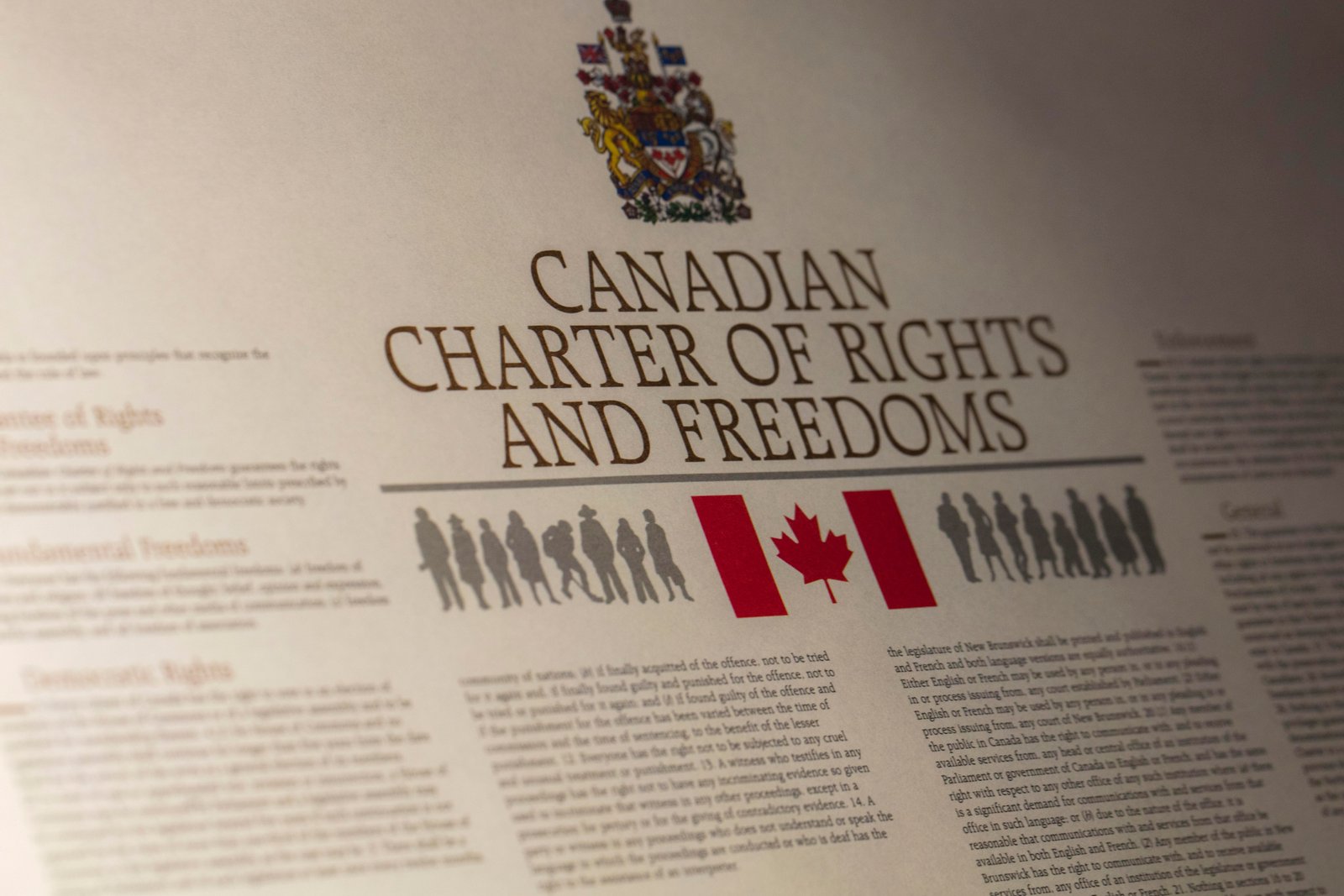
Canadian Charter of Rights and Freedoms
Constitutional document guaranteeing fundamental rights and freedoms; basis for legal challenge to CSC's prison placement policies as violating women's equality and security rights.