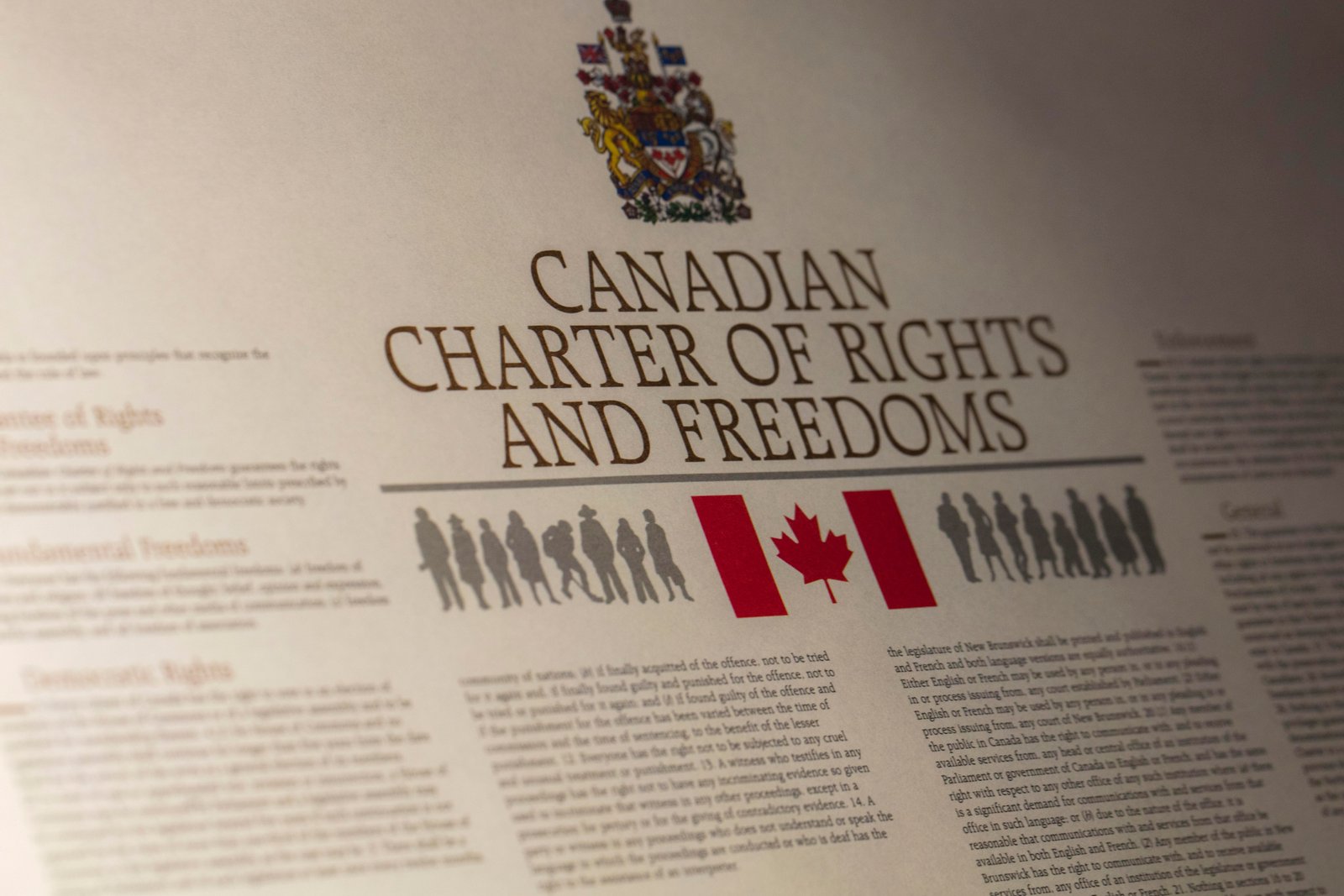
Canadian Charter of Rights and Freedoms (Constitution Act, 1982)
Constitutional document guaranteeing fundamental rights and freedoms; basis for legal challenge to CSC's prison placement policies as violating women's equality and security rights.
The Charter Challenge: Why Women's Prison Safety Is a Constitutional Issue
Canada's Charter of Rights and Freedoms is the supreme law of the land. Every law, every government policy, every administrative decision must comply with the Charter—or be struck down as unconstitutional.
In 2024, a coalition of women's organizations and incarcerated women launched a constitutional challenge to Correctional Service Canada's prison placement policy, arguing that Interim Policy Bulletin 584 violates multiple Charter rights of female inmates.
The case, brought by Canadian Women's Sex-Based Rights (caWsbar) and the Justice Centre for Constitutional Freedoms, argues that CSC's policy of placing male-bodied inmates in women's federal prisons based solely on self-identified gender identity violates:
Section 7: Women's right to security of the person
Section 15: Women's right to equality and freedom from sex-based discrimination
Section 28: The guarantee that Charter rights apply equally to male and female persons
If the challenge succeeds, CSC's policy will be invalidated as unconstitutional. Even if CSC argues the policy is a "reasonable limit" under Section 1, the government will need to prove the policy is "demonstrably justified in a free and democratic society"—a high bar they may not be able to meet.
This is the story of why women's prison safety is not just a policy question—it's a constitutional issue that goes to the heart of what equality means in Canada.
The Charter: Canada's Supreme Law
The Charter was enacted in 1982 as Part I of the Constitution Act, making it Canada's supreme constitutional law. Section 52(1) of the Constitution states: "The Constitution of Canada is the supreme law of Canada, and any law that is inconsistent with the provisions of the Constitution is, to the extent of the inconsistency, of no force or effect."
This means:
Every federal and provincial law must comply with the Charter
Every government policy and administrative decision must comply with the Charter
Courts can strike down laws or policies that violate Charter rights
Government actions that violate Charter rights are invalid unless the violation can be justified under Section 1
The Charter applies to CSC because CSC is a federal government agency. Everything CSC does—from legislation to policy to individual decisions—must comply with Charter rights.
When CSC implemented Policy Bulletin 584, allowing male-bodied inmates to be housed in women's prisons based on self-identified gender, CSC created a policy that female inmates argue violates their Charter rights. The question now before the courts is whether those violations can be justified—or whether the policy must be struck down as unconstitutional.
Section 7: Security of the Person
The Charter says: "Everyone has the right to life, liberty and security of the person and the right not to be deprived thereof except in accordance with the principles of fundamental justice."
Section 7 is one of the Charter's most fundamental protections. While it's often associated with criminal procedure (fair trial rights, protection against arbitrary detention), the Supreme Court has recognized that "security of the person" extends to protection from state-imposed psychological stress and physical danger.
What "Security of the Person" Means in Prison
The Supreme Court of Canada has recognized that while inmates necessarily lose some liberty when incarcerated, they do not lose all rights. In R v Malmo-Levine, the Court stated that Section 7 protects against "serious state-imposed psychological stress" and threats to physical integrity.
For female inmates, the presence of male-bodied individuals in their institutions creates both:
Physical security threats:
Males are on average significantly larger and stronger than females
Males commit the vast majority of sexual assaults and violent crimes
Female inmates have disproportionately high rates of prior sexual victimization
Enclosed prison environment makes it impossible to avoid male presence
Psychological security threats:
Constant anxiety and hypervigilance
Retraumatization of survivors of male violence
Loss of safe space that sex-separated facilities provided
State-imposed stress from being unable to escape male presence
The Evidence: What's Happening in Women's Prisons
While CSC has been resistant to releasing comprehensive data, evidence from Access to Information requests, inmate testimony, and correctional officer reports reveals:
Multiple male-bodied inmates have been transferred to women's federal institutions
Some transferred inmates have histories of sexual offences against women
Female inmates report fear, anxiety, and inability to speak freely
Incidents have occurred including inappropriate behavior and assault
Correctional officers describe policy confusion and safety concerns
Female inmates argue that CSC's policy deprives them of security of the person by:
Exposing them to increased physical risk from male presence
Imposing severe psychological stress from inability to avoid males
Retraumatizing survivors of male violence
Doing so without their consent and against their will
Why This Violates Fundamental Justice
Section 7 protects not just against deprivation of security, but against deprivation "except in accordance with the principles of fundamental justice."
Principles of fundamental justice include:
Decisions must not be arbitrary (unconnected to their purpose)
Decisions must not be overbroad (sweep more broadly than necessary)
Decisions must not be grossly disproportionate (impose effects out of proportion to objective)
Female inmates argue CSC's policy violates all three principles:
Arbitrary: The purpose of federal prisons is secure custody and rehabilitation. Placing male-bodied inmates with females based on self-identification alone bears no rational connection to these purposes and may undermine them by creating security risks.
Overbroad: Even if accommodating transgender inmates is a legitimate objective, wholesale transfer to opposite-sex institutions based solely on self-ID is overbroad. Less intrusive means exist (separate units, individual housing, programming access).
Grossly disproportionate: The psychological and physical security impacts on female inmates are grossly disproportionate to any benefit from institution transfer rather than alternative accommodation.
Section 15: Equality Rights
The Charter says: "Every individual is equal before and under the law and has the right to the equal protection and equal benefit of the law without discrimination and, in particular, without discrimination based on race, national or ethnic origin, colour, religion, sex, age or mental or physical disability."
Section 15 is Canada's constitutional guarantee of equality. It prohibits discrimination based on enumerated grounds (including sex) and analogous grounds (which courts have recognized include sexual orientation and gender identity).
The Discrimination Against Female Inmates
Female inmates argue CSC's policy discriminates against them on the basis of sex in multiple ways:
1. Denial of sex-based protections that male inmates retain
Male federal inmates continue to be housed in male-only institutions. They are not required to share intimate facilities—showers, toilets, sleeping areas—with female-bodied individuals who identify as men.
Female inmates have lost this protection. They are now required to share intimate facilities with male-bodied individuals, regardless of the females' consent, comfort, or safety concerns.
This is differential treatment based on sex: males get sex-based protections, females do not.
2. Exposure to risks that male inmates do not face
The reality of male violence against women means that housing male-bodied individuals with females creates risks that the reverse does not:
Males commit 98% of sexual offences in Canada
Males are on average larger and stronger than females
Female inmates have high rates of prior victimization by males
Requiring female inmates to accept male presence in intimate spaces exposes them to risks that male inmates do not face from female presence.
3. Deprivation of the benefit of sex-separated facilities
Sex-separated prisons exist precisely because of sex differences in physiology, patterns of violence, and vulnerability. The Corrections and Conditional Release Act and decades of correctional practice have recognized that females and males should be housed separately.
CSC's policy deprives female inmates of this benefit while male inmates continue to enjoy it. This is discrimination on the basis of sex.
The "Accommodation" Argument Doesn't Work
CSC might argue that the policy doesn't discriminate against females—it merely accommodates transgender inmates based on gender identity, which is also a protected ground under Section 15.
But this argument fails for several reasons:
First, accommodating one group's rights does not justify discriminating against another. Section 15 prohibits sex-based discrimination. CSC cannot defend sex-based discrimination against females by pointing to accommodation of gender identity.
Second, many forms of accommodation exist that don't require eliminating sex-based protections for females. CSC could accommodate through:
Separate housing units
Individual cells with appropriate programming access
Transfer to different security levels or regions
Enhanced medical and mental health support
CSC chose the most invasive form of accommodation—institution transfer—without considering less discriminatory alternatives.
Third, CSC has no evidence that institution transfer is necessary for the health, safety, or well-being of transgender inmates. No pilot programs were conducted. No comparative research was done. CSC simply assumed that gender identity accommodation requires opposite-sex placement.
Why This Is Substantive, Not Just Formal Discrimination
The Supreme Court has recognized that Section 15 protects against both formal discrimination (different treatment) and substantive discrimination (treatment that perpetuates disadvantage).
Female inmates face substantive discrimination because:
Women are disproportionately victims of male violence
Female inmates have extremely high rates of prior sexual trauma
Women in general have less physical power to resist male aggression
Women's historical disadvantage is perpetuated by policies that expose them to male violence
CSC's policy doesn't just treat female inmates differently—it perpetuates their substantive disadvantage as a group that has historically been subject to male violence and currently lacks the physical capacity to resist it.
Section 28: Gender Equality Guarantee
The Charter says: "Notwithstanding anything in this Charter, the rights and freedoms referred to in it are guaranteed equally to male and female persons."
Section 28 is unique in the Charter. It's not a standalone right—it's an interpretive provision that requires all other Charter rights to be "guaranteed equally to male and female persons."
The word "notwithstanding" is critical. It means Section 28 applies even if another Charter provision might seem to suggest otherwise. Section 28 functions as a constitutional guarantee that sex-based equality will not be sacrificed or subordinated to other interests.
Why Section 28 Matters for This Case
Section 28 reinforces that:
1. "Sex" means biological sex—male and female persons
Section 28 uses the terms "male and female persons." These are biological categories. The Charter distinguishes between sex (male/female) and other characteristics.
This doesn't mean gender identity isn't protected (courts have recognized it as an analogous ground under Section 15). But it does mean that when sex and gender identity appear to conflict, Section 28 requires that male and female persons' rights be protected equally.
2. Women's sex-based rights cannot be eliminated
Section 28 prevents the erosion of sex-based protections. If CSC's policy eliminates sex-based protections for female inmates while maintaining them for male inmates, Section 28 is violated.
3. Accommodation cannot come at the expense of sex equality
Section 28 requires courts to interpret the Charter in ways that preserve equality between male and female persons. This means any accommodation of gender identity must be done in ways that don't discriminate against females or deprive them of sex-based protections.
The Historical Context of Section 28
Section 28 was added to the Charter largely due to advocacy by women's groups who feared that other Charter provisions might be used to undermine sex-based protections for women. They wanted an explicit guarantee that women's equality would be preserved.
The irony is stark: Section 28 was meant to prevent exactly what CSC's policy does—the erosion of protections for females in the name of other rights or interests.
Section 1: The Justification Test
Even if CSC's policy violates Sections 7, 15, and 28, the policy could still be constitutional if it's saved by Section 1.
The Charter says: "The Canadian Charter of Rights and Freedoms guarantees the rights and freedoms set out in it subject only to such reasonable limits prescribed by law as can be demonstrably justified in a free and democratic society."
Section 1 allows the government to limit Charter rights if the limitation is:
Prescribed by law (not arbitrary government action)
Reasonable
Demonstrably justified (proven with evidence, not just asserted)
The test for Section 1 justification comes from R v Oakes and requires the government to prove:
Step 1: Pressing and Substantial Objective
The objective of the law or policy must be pressing and substantial enough to justify overriding Charter rights.
CSC would likely argue: "Protecting transgender inmates from discrimination and ensuring their safety and dignity is a pressing and substantial objective."
This might succeed. Protecting vulnerable inmates is a legitimate correctional objective.
Step 2: Rational Connection
There must be a rational connection between the policy and the objective.
Problem for CSC: There's no evidence that institution transfer is rationally connected to transgender inmate safety or dignity. Alternative accommodations (separate units, individual housing, programming access) could achieve the same objective without violating female inmates' rights.
In fact, placing some transgender inmates in opposite-sex institutions may create safety risks for those inmates as well, as they may be vulnerable to assault from other inmates.
Step 3: Minimal Impairment
The policy must impair Charter rights as little as reasonably possible while still achieving the objective.
Big problem for CSC: CSC's policy is the MOST impairing option, not the least:
No verification beyond self-identification
No requirement for medical assessment or transition
No pilot programs or evidence gathering
No consideration of criminal history (including sex offences)
Presumption in favor of transfer unless "overriding health or safety concerns"
Less impairing alternatives clearly exist:
Require evidence of consistent, long-term gender identity (not recent claims)
Require medical/psychological assessment
Exclude inmates with sexual offence histories
Create specialized units rather than full integration
Conduct individual risk assessments
Implement pilot programs before universal policy
CSC cannot prove minimal impairment because they never tried less impairing alternatives.
Step 4: Proportionate Effects
The benefits of the policy must outweigh the harms.
Major problem for CSC: CSC has no data on benefits or harms:
How many inmates have benefited from transfers?
What improvements in mental health or behavior?
How many female inmates are affected?
What psychological impacts on those females?
Have incidents increased?
Has safety been compromised?
Without evidence, CSC cannot prove proportionality. The severe impacts on female inmates' security and equality rights cannot be justified by speculative benefits that CSC has never measured.
Why CSC Will Likely Fail the Section 1 Test
For CSC to save its policy under Section 1, it needs evidence. Specifically:
Evidence the policy is necessary (not just one option among many) Evidence it's the least restrictive option (alternatives were tried and failed) Evidence the benefits outweigh harms (data showing positive outcomes)
CSC has none of this because:
The policy was implemented immediately without pilot programs
No comparative research on different accommodation models
Refusal to release data on transfers, incidents, and outcomes
No consultation with affected female inmates before implementation
No measurement of impacts on female inmates' mental health or safety
In RJR-MacDonald Inc v Canada, the Supreme Court emphasized that Section 1 requires real evidence, not speculation: "The government must show a causal connection between the infringement and the benefit sought... This connection must be established by the government on the basis of evidence, not on speculation."
CSC cannot meet this standard. They have speculation, not evidence.
The International Law Dimension
Canada's obligations under international law strengthen the Charter arguments.
The International Covenant on Civil and Political Rights (ICCPR) requires humane treatment of prisoners and the UN Standard Minimum Rules (Mandela Rules) specify sex-separated detention.
The Convention on the Elimination of All Forms of Discrimination against Women (CEDAW) obligates Canada to eliminate discrimination against women and ensure their safety.
While international treaties aren't directly enforceable in Canadian domestic law, the Supreme Court has held that the Charter should be interpreted consistently with Canada's international obligations. In Baker v Canada, the Court stated that "the values reflected in international human rights law may help inform the contextual approach to statutory interpretation and judicial review."
CSC's policy arguably violates both ICCPR (by failing to maintain sex-separated detention) and CEDAW (by exposing women to discrimination and male violence). Courts interpreting Sections 7, 15, and 28 should consider these international obligations.
What Happens If the Challenge Succeeds?
If the court finds CSC's policy violates the Charter and cannot be justified under Section 1, several outcomes are possible:
Option 1: Policy Struck Down Entirely
The court could invalidate Policy Bulletin 584 completely, requiring CSC to return to sex-based placement until Parliament provides legislative guidance.
Option 2: Policy Modified with Court-Imposed Safeguards
The court could require CSC to modify the policy to include:
Verification requirements beyond self-ID
Exclusions for inmates with sexual offence histories
Individual risk assessments
Consideration of impacts on female inmates
Higher standards for approval
Option 3: Declaration of Invalidity with Suspended Effect
The court could declare the policy unconstitutional but suspend the declaration for 12-24 months to allow Parliament to pass legislation providing proper guidance through amendments to the Corrections and Conditional Release Act.
Option 4: Court Establishes Constitutional Principles
The court could establish principles that any policy must follow:
Default sex-based placement
Gender identity accommodation through less invasive means
Exceptions only with rigorous assessment and safeguards
Ongoing monitoring and transparency
The Broader Implications
This Charter challenge has implications far beyond federal prisons:
Provincial prisons: If CSC's policy is struck down, provinces with similar self-ID policies may face Charter challenges
Other sex-separated spaces: The legal reasoning could apply to changerooms, shelters, hospital wards, and other contexts where sex-separation serves privacy and safety purposes
Definition of discrimination: The case will clarify whether eliminating sex-based protections constitutes sex discrimination even when done to accommodate gender identity
Section 28 interpretation: The case could reinvigorate Section 28 as a meaningful protection for women's sex-based rights
Limits of self-ID: The case will test whether self-identification can override other people's Charter rights
What This Means for Canadian Women
Beyond the legal technicalities, this case is about whether Canada will protect women's fundamental rights.
For incarcerated women—among the most vulnerable people in Canadian society—the stakes are immediate and personal:
Can they be safe in prison?
Do they have the right to intimate facilities without male presence?
Does their sex-based equality matter?
Will the government protect them or sacrifice them?
For Canadian women more broadly, the case raises essential questions:
Are women's sex-based rights constitutionally protected?
Can "gender identity" be used to eliminate protections for females?
Does Section 28's guarantee of equality to "male and female persons" have meaning?
Will courts enforce women's Charter rights even when politically unpopular?
Why This Case Matters
Some will argue this case is about a small number of inmates and doesn't merit constitutional attention. This misses the point entirely.
Charter cases often involve small numbers of people—that's how constitutional law develops. R v Morgentaler (abortion rights) involved a handful of plaintiffs. Rodriguez v British Columbia (assisted dying) was one person. The number of people immediately affected doesn't determine constitutional significance.
What matters is the principle: Does the government have the power to eliminate sex-based protections for females in the name of gender identity accommodation?
If the answer is yes in federal prisons, it's yes everywhere. Changerooms, shelters, hospital wards, rape crisis centers, sports—all sex-separated spaces could be eliminated if CSC's policy is upheld.
If the answer is no—if women's Charter rights to security and sex-based equality cannot be sacrificed without compelling justification—then CSC's policy must change, and all similar policies must be reconsidered.
That's why this case matters. It's not about a small number of inmates. It's about whether women's sex-based rights are constitutionally protected in Canada.
The Path Forward
The Charter challenge will take years to resolve. It may go through multiple levels of court, potentially reaching the Supreme Court of Canada.
While litigation proceeds, Parliament should act. As discussed in previous posts, Parliament should amend the Corrections and Conditional Release Act to provide clear legislative guidance on gender identity accommodation that respects both transgender inmates' dignity and female inmates' security and equality.
But if Parliament won't act—if political cowardice prevails—then the courts must enforce the Charter. That's their constitutional role.
The Charter exists precisely for moments like this: when government policies violate fundamental rights, when democratic accountability fails, when vulnerable people need constitutional protection.
Female inmates are asking the courts to enforce their Charter rights. They're asking for what the Constitution guarantees: security of the person, equality before the law, and rights guaranteed equally to male and female persons.
Conclusion: Constitution vs. Policy
Correctional Service Canada's Interim Policy Bulletin 584 is just that—a policy. It's an administrative decision made by unelected bureaucrats without legislative mandate and without meaningful consultation with affected women.
The Charter is Canada's supreme constitutional law. It protects fundamental rights. It limits government power. It ensures that even the most vulnerable people—including incarcerated women—have rights that the state cannot violate without compelling justification.
When policy conflicts with the Constitution, the Constitution wins. That's how constitutional democracy works.
CSC's policy violates female inmates' rights to security (Section 7), equality (Section 15), and sex-based protections (Section 28). CSC cannot justify these violations under Section 1 because they have no evidence that the policy is necessary, minimally impairing, or proportionate.
The question now is whether Canadian courts will enforce the Charter—or whether political pressure and gender identity ideology will override constitutional rights.
The women bringing this challenge aren't asking for special treatment. They're asking for the rights the Charter guarantees: safety, equality, and recognition that they are female persons entitled to sex-based protections.
That's not too much to ask. That's the bare minimum the Constitution requires.
Key Provisions
Section 7: 'Everyone has the right to life, liberty and security of the person' - female inmates argue male presence violates their security
Section 15(1): Equality rights - prohibits discrimination based on enumerated and analogous grounds including 'sex' - women argue they're discriminated against by forced housing with males
Section 28: Rights guaranteed equally to 'male and female persons' - reinforces sex-based equality protections
Section 1: Rights can be limited if 'demonstrably justified in a free and democratic society' - government must prove limitations are reasonable
Legal Challenge: caWsbar/Justice Centre Charter challenge argues CSC policy violates Sections 7, 15, and 28
Ministerial Chain of Custody:
The Canadian Charter of Rights and Freedoms has a short and well-documented ministerial chain. It is entrenched constitutional law, not ordinary statute, which means amending it requires a formal constitutional process. It cannot be quietly revised by administrative policy or reinterpreted by a single minister.
Pierre Trudeau served as Prime Minister of Canada from 1980 to 1984 during the patriation of the Constitution. The Charter was his signature political achievement — the culmination of his vision for a unified, rights-based Canada that he had articulated since his 1968 paper A Canadian Charter of Human Rights. He signed the Proclamation of the Constitution Act, 1982, alongside Queen Elizabeth II on April 17, 1982. The Charter's Section 15 equality provisions, including the prohibition on discrimination based on sex, reflect the framework Trudeau championed. Section 28, which guarantees Charter rights equally to male and female persons, was added after women's groups lobbied during the constitutional negotiations to ensure that sex-based equality had explicit constitutional protection — a fact that is directly relevant to the current Charter challenge over CSC's prison placement policy.
Jean Chrétien served as Minister of Justice and Attorney General of Canada from March 1980 to June 1982, the period during which the Charter was negotiated, drafted, and enacted. He was the minister responsible for the legal drafting of the Charter and signed the Proclamation alongside Trudeau and the Queen. As the minister who drafted the document, he is one of the originating authorities for the sex-based equality protections now being invoked in Charter litigation against CSC's gender-diverse offender policy.
The ministerial accountability question the Charter raises is different from the accountability questions raised by the legislative and policy entries in this database. No minister created the Charter's conflict with CSC's policy — CSC created that conflict by adopting a policy that female inmates argue violates their Charter rights under Sections 7, 15, and 28. The Charter itself is the tool of accountability. The ministers and officials responsible for applying it correctly are documented in the other entries in this series.
References:
Canadian Charter of Rights and Freedoms, Part I of the Constitution Act, 1982, being Schedule B to the Canada Act 1982 (UK), 1982, c 11, online: https://laws-lois.justice.gc.ca/eng/const/page-12.html.
Correctional Service Canada, Interim Policy Bulletin 584: Gender Identity or Expression (27 December 2017), online: Public Safety Canada https://www.publicsafety.gc.ca/cnt/trnsprnc/brfng-mtrls/prlmntry-bndrs/20200621/023/index-en.aspx.
Canadian Women's Sex-Based Rights (caWsbar), online: https://cawsbar.ca/.
R v Malmo-Levine, 2003 SCC 74, online: https://scc-csc.lexum.com/scc-csc/scc-csc/en/item/2028/index.do.
Corrections and Conditional Release Act, SC 1992, c 20, online: https://laws-lois.justice.gc.ca/eng/acts/C-44.6/.
R v Oakes, [1986] 1 SCR 103, online: https://scc-csc.lexum.com/scc-csc/scc-csc/en/item/117/index.do.
RJR-MacDonald Inc v Canada (Attorney General), [1995] 3 SCR 199, online: https://scc-csc.lexum.com/scc-csc/scc-csc/en/item/1290/index.do.
International Covenant on Civil and Political Rights, 19 December 1966, 999 UNTS 171, Can TS 1976 No 47 (entered into force 23 March 1976, accession by Canada 19 May 1976), online: https://www.ohchr.org/en/instruments-mechanisms/instruments/international-covenant-civil-and-political-rights.
Convention on the Elimination of All Forms of Discrimination against Women, 18 December 1979, 1249 UNTS 13, Can TS 1982 No 31 (entered into force 3 September 1981, ratification by Canada 10 December 1981), online: https://www.ohchr.org/en/instruments-mechanisms/instruments/convention-elimination-all-forms-discrimination-against-women.
Baker v Canada (Minister of Citizenship and Immigration), [1999] 2 SCR 817, online: https://scc-csc.lexum.com/scc-csc/scc-csc/en/item/1699/index.do.
Read More
text
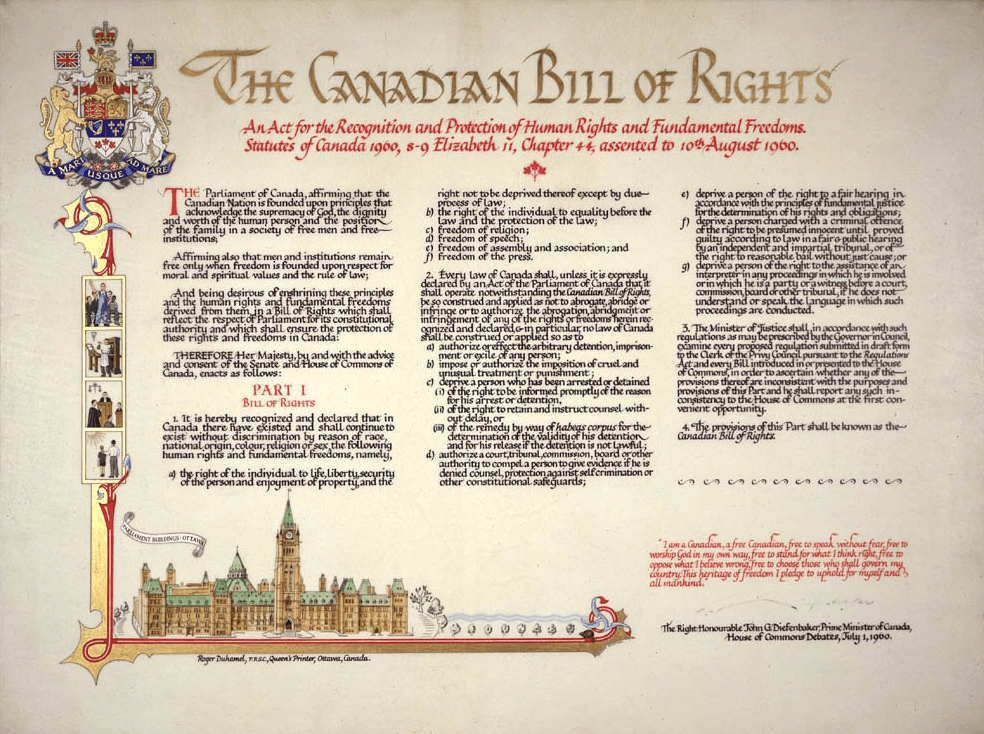
Canadian Bill of Rights
Canada's first federal human rights statute, enacted in 1960 under Prime Minister Diefenbaker; protects equality before the law without discrimination by sex — and is directly named in caWsbar's Charter challenge as violated by CSC's prison placement policy, making it an active legal instrument, not merely a historical one.
text
Canadian Human Rights Act
Federal anti-discrimination law prohibiting discrimination in federally-regulated employment and services based on protected grounds including sex (1985) and gender identity/expression (added 2017 via Bill C-16).