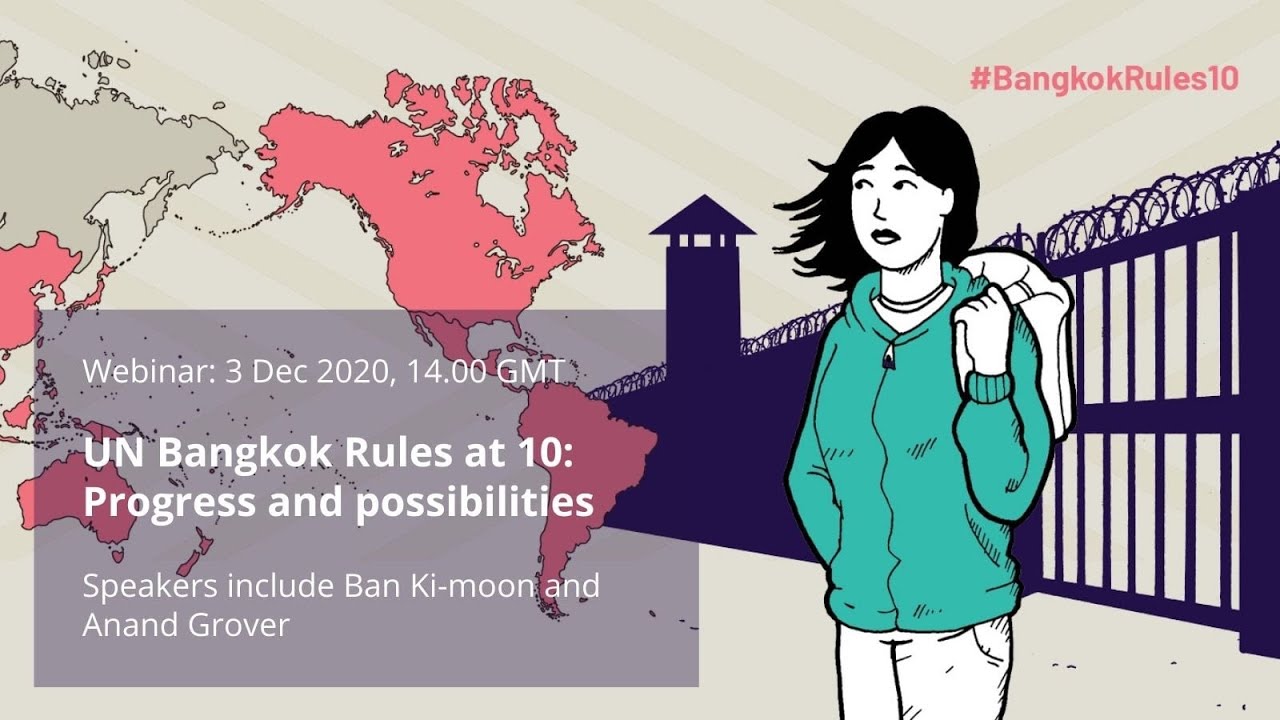
United Nations Rules for the Treatment of Women Prisoners and Non-custodial Measures for Women Offenders (the Bangkok Rules)
United Nations Rules for the Treatment of Women Prisoners (Bangkok Rules) - international standard requiring gender-specific prison policies and recognizing women's distinct needs and vulnerabilities.
International Standards Canada Is Ignoring: The UN Bangkok Rules
On December 21, 2010, the United Nations General Assembly adopted Resolution 65/229, establishing the United Nations Rules for the Treatment of Women Prisoners and Non-custodial Measures for Women Offenders — known as the Bangkok Rules. They were the first international standards ever developed specifically for incarcerated women, and they emerged from a recognition that existing prison standards — written largely with male inmates in mind — were failing to account for the distinct vulnerabilities, needs, and rights of women in custody.
Canada voted in favour of the resolution. Canada ratified the underlying framework. Canada, as a matter of international law, is bound by the principles the Bangkok Rules encode.
Canada is now violating them.
The placement of male-bodied inmates in federal women's institutions under Commissioner's Directive 100 — a policy Correctional Service Canada has operated since December 2017 — conflicts directly with the Bangkok Rules' requirements for female-only supervision, sex-specific accommodation, and recognition of the distinct vulnerabilities women bring to the prison environment. No Canadian official has publicly explained how CD-100 is compatible with Canada's Bangkok Rules obligations. No compliance analysis has been published. The conflict has simply been ignored.
This is the story of a set of international standards Canada helped create — and is now pretending do not apply.
What the Bangkok Rules Are
The Bangkok Rules are 70 operational standards adopted by the UN General Assembly to supplement the existing Standard Minimum Rules for the Treatment of Prisoners — the Mandela Rules — with provisions specific to women. They address the full arc of incarceration: intake, classification, healthcare, accommodation, contact with family, disciplinary procedures, and reintegration.
They were developed because the General Assembly recognized that women enter prison carrying a distinct burden. Globally, the majority of incarcerated women are imprisoned for non-violent offences. They are more likely than male inmates to have experienced physical and sexual abuse before incarceration. They are more likely to have primary caregiving responsibilities for children. They have distinct medical and mental health needs. And they are overwhelmingly incarcerated in facilities designed by and for a predominantly male prison population.
The Bangkok Rules exist to correct this. They are grounded in the recognition that equal treatment of unequal populations is not justice — that treating incarcerated women the same as incarcerated men produces worse outcomes for women, not better ones.
Their preamble states: "Bearing in mind that a number of women prisoners are pregnant or accompanied by children, and that their specific needs and vulnerabilities should be addressed in a gender-sensitive manner." And: "Recognizing that a large number of women in prison have experienced gender-based violence prior to incarceration and that their specific needs and vulnerabilities should be taken into account."
What follows are 70 rules built on those recognitions. What Canada's current prison policy produces is something that contradicts them.
The Rules Canada Is Violating
The Bangkok Rules most directly relevant to the question of cross-sex inmate placement fall into three categories: supervision, searches, and accommodation.
Rule 40: Female-Only Supervision
Rule 40 provides: "Women prisoners shall be supervised only by female staff members in areas in which the prisoner is undressed or is receiving personal hygiene treatment."
This rule reflects a well-documented reality: women in prison have overwhelmingly experienced male-perpetrated violence before incarceration. The Bangkok Rules' preamble notes this explicitly. Requiring women to be undressed in spaces observable by or supervised by males — for any reason, regardless of how that male identifies — replicates the conditions of vulnerability that incarceration is meant to safely contain, not reproduce.
Canada's current policy allows male-bodied inmates to be housed in women's federal institutions. Those inmates are present in the accommodation areas the Bangkok Rules designate as female-supervised. Rule 40 is not ambiguous. It does not contain an exception for male-bodied individuals who identify as women. Canada's practice conflicts with this rule.
Rule 41: Female-Only Searches
Rule 41 provides: "Only female staff shall conduct body searches of women prisoners."
This rule's practical implications for a women's institution housing male-bodied inmates are significant. If a male-bodied inmate who identifies as a woman is housed in a women's institution and that inmate is subject to search, how is the institution to comply? Either female staff conduct the search of a male-bodied individual, or male staff conduct the search in violation of Rule 41, or a bespoke protocol is developed that satisfies neither standard.
CSC has not published any analysis of how its gender-diverse offender policy reconciles this conflict. The conflict is not acknowledged in Commissioner's Directive 100. It is simply not addressed.
Rule 19: Gender-Specific Healthcare
Rule 19 provides that women prisoners shall receive healthcare "that responds to their specific health-care needs, including reproductive health." Related rules require that pregnancy, childbirth, and the postpartum period be managed in institutions with appropriate medical support.
Federal women's institutions in Canada include mother-child programs — units where infants and young children can reside with their incarcerated mothers. The Bangkok Rules directly contemplate this arrangement and require that the best interests of the children be the paramount consideration in all decisions affecting them. The presence of male-bodied inmates in these units is a matter CSC has not publicly addressed.
The Relationship Between Bangkok Rules and Binding Canadian Law
A standard objection to Bangkok Rules-based arguments is that the Rules are not binding domestic law. This is correct as far as it goes — but it goes less far than the objection implies.
The Supreme Court of Canada established in Baker v Canada (Minister of Citizenship and Immigration) that "the values reflected in international human rights law may help inform the contextual approach to statutory interpretation and judicial review." This means the Bangkok Rules are not legally irrelevant. They are evidence of what the international community — including Canada — has recognized as the appropriate treatment of incarcerated women.
The Bangkok Rules are relevant to three distinct legal questions in the Canadian context:
First, Charter interpretation. When courts interpret Section 7 (security of the person) and Section 15 (equality) of the Canadian Charter of Rights and Freedoms in the context of incarcerated women's rights, the Bangkok Rules provide an internationally recognized baseline for what those rights require.
Second, Section 1 justification. If a court finds that CD-100 violates incarcerated women's Charter rights, the government must demonstrate the violation is "demonstrably justified in a free and democratic society." Justification is harder to establish when the policy conflicts with international standards Canada has endorsed.
Third, statutory interpretation. The Corrections and Conditional Release Act, interpreted in light of Canada's international obligations, should be read consistently with the Bangkok Rules wherever possible. CSC's interpretation of the CCRA as permitting the conversion of sex-separated women's institutions into gender-identity-segregated ones is strained when read against Canada's international obligations.
The Mandela Rules: Sex Separation as an International Minimum Standard
The Bangkok Rules should be read alongside the United Nations Standard Minimum Rules for the Treatment of Prisoners — the Mandela Rules — which establish baseline standards for all incarcerated persons regardless of sex.
Rule 11(a) of the Mandela Rules provides: "Men and women shall so far as possible be detained in separate institutions; in an institution which receives both men and women, the whole of the premises allocated to women shall be entirely separate."
This is not a suggestion. It is an international minimum standard — the floor below which no UN member state's correctional practice should fall. Sex separation in prisons predates every modern human rights instrument. It is a baseline recognized across legal traditions, cultures, and political systems.
Canada's policy of placing male-bodied inmates in women's federal institutions based on self-declaration — without surgical requirement, without extended medical verification, without individual risk assessment — falls below this standard. CSC has not published any analysis explaining how its current policy meets the Mandela Rules' requirement. The conflict is treated as if it does not exist.
CEDAW and the Bangkok Rules: A Reinforcing Framework
The Bangkok Rules are grounded in, and reinforce, Canada's obligations under the Convention on the Elimination of All Forms of Discrimination against Women (CEDAW), ratified by Canada in 1981.
CEDAW requires Canada to "pursue by all appropriate means... a policy of eliminating discrimination against women" and to take measures ensuring "the full development and advancement of women." The CEDAW Committee's General Recommendation 35 specifically addresses gender-based violence against women — recognizing the particular vulnerability of incarcerated women and the state's obligation to protect them.
The Bangkok Rules operationalize these CEDAW obligations in the corrections context. They translate the treaty's broad requirements into specific institutional practices: female supervision, female searches, sex-specific healthcare, facilities designed for women. When Canada implements a corrections policy that eliminates these protections in the name of gender identity accommodation, it undermines both its Bangkok Rules commitments and its CEDAW obligations simultaneously.
This double violation has not been addressed by the Minister of Public Safety, the Minister for Women and Gender Equality, or Status of Women Canada.
The Women Who Need These Protections
The Bangkok Rules were not created in abstraction. They emerged from testimony about what happens to women when correctional systems fail to account for their distinct reality.
In Canada's federal women's institutions, the population is not a generic inmate population. It is overwhelmingly survivors of male violence — studies of federally incarcerated women in Canada consistently report rates of prior physical and sexual abuse above 80%. It is disproportionately Indigenous — Indigenous women now represent approximately 50% of the federal women's prison population despite comprising approximately 5% of the Canadian adult female population. It is frequently incarcerated for survival-related offences. It is often mothers — federal women's institutions run mother-child programs specifically because the incarceration of mothers has distinct consequences for children.
The Bangkok Rules were written for this population. Every protection they establish — female supervision, female searches, sex-specific healthcare, trauma-informed programming — was calibrated to the reality of who is incarcerated in women's prisons and what they carry into custody with them.
A policy that introduces male-bodied individuals into this population — including individuals convicted of violence and sexual offences against women — does not neutrally expand who benefits from Bangkok Rules protections. It actively undermines the conditions those protections were designed to create: spaces where women who have been harmed by men can begin to be safe.
The Accountability Vacuum
Canada reports to the UN Human Rights Committee on its compliance with the International Covenant on Civil and Political Rights and to the CEDAW Committee on its compliance with CEDAW. These reporting obligations include the treatment of incarcerated persons.
Canada has not disclosed in its treaty body reporting that it has adopted a policy allowing male-bodied inmates to be housed in women's federal prisons based on self-identification. It has not described how that policy is reconciled with the Bangkok Rules, the Mandela Rules, or CEDAW. It has not invited scrutiny of the policy from the treaty bodies whose mandate includes exactly this kind of assessment.
The international framework Canada helped build creates reporting obligations that are supposed to make these policy choices visible. The machinery exists. Canada is choosing not to use it.
What Compliance Would Actually Look Like
The Bangkok Rules do not require that transgender-identified inmates receive no accommodation. They require that accommodation not come at the expense of the protections incarcerated women are entitled to under international standards.
A corrections policy that complies with the Bangkok Rules would maintain sex-separated institutions for female inmates, with female-only supervision and female-only search protocols. It would accommodate transgender-identified male inmates through individualized protocols within men's institutions — access to gender-affirming healthcare, respectful treatment, protection from harassment — rather than through cross-sex transfer. It would develop specialized units for gender-diverse offenders where integration into either general population creates irresolvable conflicts, rather than defaulting to the women's population as the accommodation site. And it would conduct and publish an explicit Bangkok Rules compliance analysis before implementing any policy that changes the sex composition of women's federal institutions.
None of this requires treating transgender-identified inmates with cruelty or indifference. It requires recognizing — as the Bangkok Rules recognized in 2010 — that incarcerated women's distinct vulnerabilities create distinct obligations that cannot be discarded because a different set of accommodation claims has been made a priority.
Conclusion: Rules Canada Helped Write, and Is Now Ignoring
Canada did not merely ratify the Bangkok Rules. Canada played an active role in the international corrections reform movement that produced them. Canadian corrections researchers, advocates, and government officials contributed to the development of women-specific international standards. That work produced obligations — including female-only supervision of women in custody, female-only searches, sex-specific healthcare, and accommodation calibrated to the reality that incarcerated women have overwhelmingly experienced violence at the hands of men.
Commissioner's Directive 100 places male-bodied individuals in women's federal institutions. Male-bodied inmates are present in spaces the Bangkok Rules designate as female-supervised. The sex-specific protections the Rules require are operationally degraded by a policy that treats self-declared gender identity as equivalent to biological sex for every correctional purpose.
Canada has not explained how this is consistent with the Bangkok Rules. It has not published a compliance analysis. It has not reported the conflict to the treaty bodies whose job is to assess it.
The Charter challenge filed on April 7, 2025, will force a domestic reckoning with what Canada's own Constitution requires. The Bangkok Rules, CEDAW, and the Mandela Rules exist to demand the same reckoning at the international level. The women in Canada's federal prisons are owed both.
Key Provisions
Rule 40: Women prisoners shall be supervised only by female staff in areas where they are undressed or receiving personal hygiene treatment
Rule 41: Only female staff shall conduct body searches of women prisoners
Rule 4: Women prisoners' specific hygiene needs shall be met, including sanitary products provided free of charge
Rule 19: Women prisoners shall receive healthcare that responds to their specific needs, including reproductive health
Rule 10(3): Women prisoners shall have access to a balanced programme of activities that takes account of gender-appropriate needs
Mandela Rules 11(a): Men and women shall so far as possible be detained in separate institutions — the baseline standard the Bangkok Rules supplement
Canada's Conflict: Placing male-bodied inmates in women's prisons under CD-100 violates the spirit and specific requirements of Rules 40 and 41 and conflicts with the Mandela Rules' sex-separation standard
Ministerial Chain of Custody:
The Bangkok Rules create two distinct chains of ministerial accountability: the officials responsible for Canada's endorsement of the Rules in 2010, and the officials responsible for the correctional policy that has been in conflict with those Rules since 2017. Both chains matter. The first establishes what Canada committed to. The second establishes who decided to break that commitment without ever saying so publicly.
Endorsement and Treaty Obligation (2010)
Vic Toews served as Minister of Public Safety from May 2011 to July 2013 under Prime Minister Stephen Harper. At the time Canada endorsed the Bangkok Rules in December 2010, Peter Van Loan held the portfolio. Both men presided over a federal corrections system that — at that point — was operating in compliance with the Rules through sex-separated institutions and female-only supervision of incarcerated women. That compliance was the inherited baseline. It did not require active effort; it was the default.
Don Head served as Commissioner of Correctional Service Canada from June 2008 to 2018. He was Commissioner when the Bangkok Rules took effect and when Canada's correctional practice was still consistent with them. He was also Commissioner when Interim Policy Bulletin 584 was issued on December 27, 2017 — the document that initiated the conflict with the Bangkok Rules' female-only supervision and sex-separation requirements. His signature appears on the policy that began Canada's non-compliance.
The Ministers Who Created the Conflict (2017–present)
Ralph Goodale served as Minister of Public Safety and Emergency Preparedness from November 2015 to November 2019. He was the minister of record when Interim Policy Bulletin 584 was issued in December 2017, creating the policy that conflicts with Bangkok Rules 40 and 41. His office would have been responsible for assessing whether the new policy was consistent with Canada's international obligations. No such assessment was published.
Bill Blair served as Minister of Public Safety from November 2019 to October 2021. He was the minister responsible during the consultation period for Commissioner's Directive 100, the document that formalized the Bangkok Rules conflict into permanent policy. The draft CD-100 circulated for stakeholder comment in October 2020 under his tenure. No Bangkok Rules compliance analysis accompanied the draft.
Marco Mendicino served as Minister of Public Safety from October 2021 to July 2023. He was the minister of record when Commissioner's Directive 100 took effect on May 9, 2022, formally entrenching a policy that conflicts with Canada's international obligations to incarcerated women. He has since lost his seat in the 2025 federal election.
Dominic LeBlanc served as Minister of Public Safety beginning July 2023. He was the minister during the announcement of CD-100's compliance review in January 2024 — a review that has produced no public output in over two years.
Gary Anandasangaree is the current Minister of Public Safety under Prime Minister Mark Carney's government. As of May 2026, the Bangkok Rules conflict continues unaddressed and unacknowledged under his ministerial responsibility.
The Ministers Who Should Have Flagged This
Ministers responsible for Women and Gender Equality — the portfolio formerly called Status of Women Canada — bear a separate accountability. Their mandate specifically includes ensuring Canada meets its international obligations to women, including CEDAW and the Bangkok Rules. The ministers who have held this portfolio since the conflict began include Maryam Monsef (2015–2021), Marci Ien (2021–2023), and their successors. None has publicly addressed the conflict between Canada's gender-diverse offender policy and the Bangkok Rules. None has published a GBA+ analysis of how the policy affects federally incarcerated women in light of Canada's international commitments.
Ministers of Foreign Affairs and Global Affairs Canada are responsible for Canada's reporting to UN treaty bodies, including the Human Rights Committee (ICCPR) and the CEDAW Committee. Canada's most recent reviews before those bodies did not disclose the adoption of a self-identification-based prison placement policy or invite scrutiny of its compatibility with the Bangkok Rules and Mandela Rules. The ministers responsible for those omissions in Canada's treaty reporting span both the Trudeau and Carney governments.
Current Accountability
Talal Dakalbab was appointed Commissioner of Correctional Service Canada in March 2026. He inherits the Bangkok Rules conflict, the unpublished compliance review, and the ongoing Charter challenge. His office now bears operational accountability for a policy whose international illegality has never been publicly assessed.
Anne Kelly served as Commissioner from July 2018 to March 2026. She signed Commissioner's Directive 100 and oversaw its implementation. Her tenure as Deputy Commissioner for Women from 2004 to 2006 — a role that existed specifically to represent the rights and needs of incarcerated women — makes the absence of a Bangkok Rules compliance analysis during her commissionership particularly difficult to explain.
Amy Jarrette serves as Deputy Commissioner for Women, appointed December 2023. Under CD-100, she is the final decision-maker for every transfer into Canada's six federal women's prisons. Each placement decision she approves is a decision made inside a policy framework that has never been reconciled with the Bangkok Rules requirements for female-only supervision that those institutions are supposed to maintain.
References:
United Nations Rules for the Treatment of Women Prisoners and Non-custodial Measures for Women Offenders (the Bangkok Rules), GA Res 65/229, UNGAOR, 65th Sess, UN Doc A/RES/65/229 (2010): https://www.unodc.org/documents/justice-and-prison-reform/Bangkok_Rules_ENG_22032015.pdf
United Nations Standard Minimum Rules for the Treatment of Prisoners (the Mandela Rules), GA Res 70/175, UNGAOR, 70th Sess, UN Doc A/RES/70/175 (2015), Rules 11(a), 11(b).
Convention on the Elimination of All Forms of Discrimination against Women, 18 December 1979, 1249 UNTS 13, Can TS 1982 No 31 (ratification by Canada 10 December 1981): https://www.ohchr.org/en/instruments-mechanisms/instruments/convention-elimination-all-forms-discrimination-against-women
International Covenant on Civil and Political Rights, 19 December 1966, 999 UNTS 171, Can TS 1976 No 47, art 10: https://www.ohchr.org/en/instruments-mechanisms/instruments/international-covenant-civil-and-political-rights
Correctional Service Canada, Commissioner's Directive 100: Gender Diverse Offenders (in effect 9 May 2022): https://www.canada.ca/en/correctional-service/corporate/acts-regulations-policy/commissioners-directives/100.html
Corrections and Conditional Release Act, SC 1992, c 20: https://laws-lois.justice.gc.ca/eng/acts/C-44.6/
Canadian Charter of Rights and Freedoms, Part I of the Constitution Act, 1982, ss 7, 15: https://laws-lois.justice.gc.ca/eng/const/page-12.html
Baker v Canada (Minister of Citizenship and Immigration), [1999] 2 SCR 817: https://scc-csc.lexum.com/scc-csc/scc-csc/en/item/1699/index.do
CEDAW Committee, General Recommendation No 35 on gender-based violence against women (2017): https://www.ohchr.org/en/documents/general-comments-and-recommendations/general-recommendation-no-35-gender-based-violence
Office of the Correctional Investigator, annual reports: https://oci-bec.gc.ca/
Justice Centre for Constitutional Freedoms, Charter Challenge on Behalf of caWsbar (filed 7 April 2025): https://www.jccf.ca/
Canadian Women's Sex-Based Rights (caWsbar): https://cawsbar.ca/
