
Physical Activity and Sport Act, S.C. 2003, c. 2
Canada's primary federal sport statute; establishes the policy framework under which Sport Canada funds national sport organizations. Does not define "female" or "male" anywhere in its text and has never been amended to address the conflict between sex and gender identity in sport eligibility.
The Physical Activity and Sport Act: The Law That Never Defined Women's Sport
When Parliament passed the Physical Activity and Sport Act in 2003, it replaced the Fitness and Amateur Sport Act of 1961 with what it described as legislation better adapted to contemporary realities. The Act established the framework under which Sport Canada funds national sport organizations, set out the Government of Canada's sport policy, and created the Sport Dispute Resolution Centre of Canada.
What the Act did not do — and what Parliament has never done in any subsequent amendment — is define what it means to be a female athlete in Canada. The word "female" does not appear in the Act's operative provisions. The word "male" does not appear either. The categories that make women's sport possible — the biological distinctions between male and female that justify sex-segregated competition — are nowhere to be found in Canada's primary federal sport statute.
This is the story of an Act whose silence on the most fundamental question in women's sport has allowed the policy framework governing female athletic competition to be determined by administrative guidance rather than democratic legislation.
What the Act Actually Says
The Physical Activity and Sport Act is a relatively brief statute. Its substantive provisions fall into three categories: the physical activity policy framework, the sport policy framework, and the establishment of the Sport Dispute Resolution Centre.
Section 3 | Sets out the objectives of Canada's physical activity policy: promoting activity as a fundamental element of health, encouraging all Canadians to improve their health by integrating activity into daily life, and assisting in reducing barriers to being active. |
Section 4 | Establishes the sport policy framework. Its first subsection states that the Government of Canada's sport policy is founded on the highest ethical standards and values, including doping-free sport, the treatment of all persons with fairness and respect, the full and fair participation of all persons in sport, and the fair, equitable, transparent and timely resolution of disputes in sport. |
Section 4(2) | Are to increase participation in sport and support the pursuit of excellence, and to build capacity in the Canadian sport system. |
Section 5 | Sets out the objects of the Act and the Minister's authority. The Minister may take any measures considered appropriate to encourage, promote and develop physical activity and sport. Specific measures listed include undertaking research, arranging conferences, providing recognition of achievement, distributing information, and facilitating the participation of under-represented groups in the Canadian sport system. |
Sections 9 through 37 | Establish and govern the Sport Dispute Resolution Centre of Canada, an independent not-for-profit corporation whose mission is to provide the sport community with a national alternative dispute resolution service. That, in essence, is the Act. It is an enabling and framework statute. It does not itself fund sport organizations, set eligibility standards, define competitive categories, or address the composition of national teams. Those functions are performed through Sport Canada's administrative programs — funded under the Act's authority but not defined by it. |
What the Act Does Not Say
What matters most for understanding women's sport is what the Act does not contain.
The Act does not define "female" or "male." In the context of sport — where sex-segregated competition exists precisely because biological differences between males and females create competitive disparities — this is not a minor drafting gap. It is the absence of the foundational definition on which all of women's sport depends.
The Act does not define "fairness" in competitive sport. Section 4(1)'s reference to "the full and fair participation of all persons in sport" is the closest the Act comes to addressing competitive integrity. But "fair" is never defined. Whether fairness requires sex-based eligibility standards, or whether it can be satisfied by gender identity-based standards, is a question the Act does not answer.

The Act does not address the female category in sport. The words "women's sport," "female category," or "sex-segregated competition" do not appear. The Act does not require that a female category exist, does not define who may compete in it, and does not authorize or prohibit any particular eligibility standard.
The Act has never been amended to address the conflict between sex and gender identity. When Bill C-16 added "gender identity or expression" to the Canadian Human Rights Act in 2017, Parliament amended several statutes. The Physical Activity and Sport Act was not one of them. No amendment has been introduced since to address how the Act's commitment to "the full and fair participation of all persons in sport" applies when a male-bodied athlete claims the right to compete in the female category based on gender identity.
The Founding Premise of Women's Sport
Women's sport exists because biological sex differences are real, material, and relevant to athletic competition. Males who undergo male puberty develop on average greater muscle mass, bone density, lung capacity, and cardiovascular efficiency than females. These differences are not erased by hormone therapy — World Athletics, World Aquatics, and other international federations have conducted extensive research confirming that male physiological advantages persist for years or indefinitely after testosterone suppression.
The female category in sport is not simply a category for people who identify as women. It is a protected competitive space created specifically for biological females, designed to ensure that female athletes have an opportunity to compete on a roughly equal playing field with others who share their biology.
Without a biological basis for the female category, the category has no principled foundation. It becomes something other than what it was designed to be — and the women who built their athletic careers in it, who devoted years to training to compete on a genuinely level field, are told that the definition of what they are competing in has changed without their input, without scientific justification, and without democratic accountability.
Canada's primary federal sport statute contains none of this. It contains no recognition that sex differences are relevant to sport. It contains no protection for the female category. It contains no definition that would ground an eligibility standard in biological reality.
The Legislative Gap and What It Permits
The Physical Activity and Sport Act's silence on sex-based eligibility does not mean that eligibility decisions are unregulated. It means they are regulated by administrative policy rather than law.
Sport Canada's position — reflected in internal guidance documents released under Access to Information requests — is that it has no official policy on transgender inclusion in sport. National sport organizations are encouraged to find "innovative, evidence-based solutions" that afford respect to transgender athletes while preserving fairness and safety for female athletes.
This is not a policy. It is an abdication. Sport Canada is funding 63 national sport organizations to the tune of hundreds of millions of dollars annually with no requirement that those organizations maintain any particular standard for who may compete in the female category.
The federal government's own internal documents acknowledge that Sport Canada assessed whether biology-based eligibility policies by organizations like Aquatics Canada "engage CHRA concerns" and concluded there was "no basis for considering" that they did — and then did nothing further. Acknowledging that sex-based eligibility is likely legal, and then failing to require it as a condition of funding, is a choice. It is a choice that places the fairness of women's sport at the discretion of each individual sport organization rather than in statute.

The Aquatics Canada Precedent
In 2022, Aquatics Canada voted to adopt the World Aquatics policy restricting the female category to athletes who have not undergone male puberty. World Aquatics had conducted a thorough review of the science and concluded that male physiological advantages in swimming are not eliminated by hormone therapy, and that a meaningful female category requires excluding athletes who experienced male puberty.
When Aquatics Canada adopted this policy, Sport Canada's internal guidance noted that there was "no basis for considering whether the provision of funding by Sport Canada to Aquatics Canada, or any NSO supporting a similar gender policy, engages CHRA concerns." In other words, Sport Canada's own assessment was that biology-based eligibility policies are likely legally defensible.
The federal government then did nothing. It did not make biology-based eligibility a condition of funding for other national sport organizations. It did not issue guidance to sport organizations about what eligibility standards are consistent with federal law. It acknowledged that sex-based eligibility is likely legal, declined to act on that conclusion, and left every other national sport organization to navigate the question independently.
This inconsistency is not accidental. It is the product of an Act that gives the federal government authority over sport without requiring it to take any particular position on what sport's most fundamental competitive category means.
What "Full and Fair Participation" Actually Requires
Section 4(1) of the Physical Activity and Sport Act commits the Government of Canada's sport policy to "the full and fair participation of all persons in sport." This phrase is used to justify both inclusion of transgender athletes in the female category and exclusion of males from the female category, depending on who is making the argument.
Neither interpretation is imposed by the statute. Neither is required by it. The phrase is broad enough to support almost any position, which means it supports none of them with any force.
What "full and fair participation" means for female athletes — athletes who, without a biology-based female category, have no meaningful category to compete in — is a question the Act has never answered. Females do not have "full and fair" participation in a sport system that allows males who experienced male puberty to compete in the female category. The fairness that matters for female athletes is fairness relative to their biological peers, not fairness relative to male-bodied athletes whose physiology developed under the influence of testosterone.
The Act's language is capable of protecting women's sport. It has never been interpreted to require it.
What Responsible Legislation Would Look Like
Parliament has had more than two decades to address the question of female sport eligibility in federal statute. It has not done so. A responsible amendment to the Physical Activity and Sport Act would address several questions the current statute leaves open.
First, a definition of "female" for sport purposes. The Act should define the female category in competitive sport by reference to biological sex — specifically, by reference to whether an athlete has undergone male puberty. This definition would be consistent with the approach taken by World Athletics, World Aquatics, and an increasing number of international sport federations, all of which have concluded on the basis of scientific evidence that male puberty creates physiological advantages that are not reversed by subsequent hormone therapy.
Second, a requirement that federally funded sport organizations maintain biology-based eligibility for the female category. The Act currently allows the Minister to facilitate the participation of under-represented groups in the Canadian sport system. It does not require that the female category — itself a space created for a historically under-represented group — be protected as a biology-based category. An amendment requiring that Sport Canada funding be conditional on maintaining a science-based female category standard would close the gap between federal law and the eligibility protections female athletes need.
Third, a definition of "fairness" that acknowledges biological reality. The Act's commitment to "the full and fair participation of all persons in sport" should be interpreted in light of the scientific evidence on sex differences in athletic performance. Parliament should make explicit that fairness in competitive sport requires recognition of biological sex as the appropriate basis for sex-segregated competition.
Fourth, a requirement for evidence-based eligibility standards. The Act could require that national sport organizations receiving federal funding adopt eligibility standards for the female category that are grounded in peer-reviewed scientific evidence about sex differences in athletic performance, rather than leaving those standards to be determined by advocacy-driven guidelines or gender self-identification policy.
None of this has happened. Parliament passed the Physical Activity and Sport Act in 2003, has amended it in minor procedural respects since, and has never used it to protect the female category in Canadian sport.
The Democratic Accountability Failure
Women's sport in Canada is governed by a patchwork of administrative decisions made by national sport organizations, Sport Canada funding guidance, and the positions of international sport federations — with no democratic foundation in statute. When female athletes ask who decided that males can compete in the female category, or who decided they cannot, the answer is: nobody voted on it.
The Physical Activity and Sport Act authorizes federal involvement in sport. It does not shape it. The Minister may take any measures considered appropriate. What "appropriate" means for female athletic competition is left entirely to ministerial discretion — discretion that has, for decades, been exercised without any requirement that it protect the competitive integrity of women's sport.
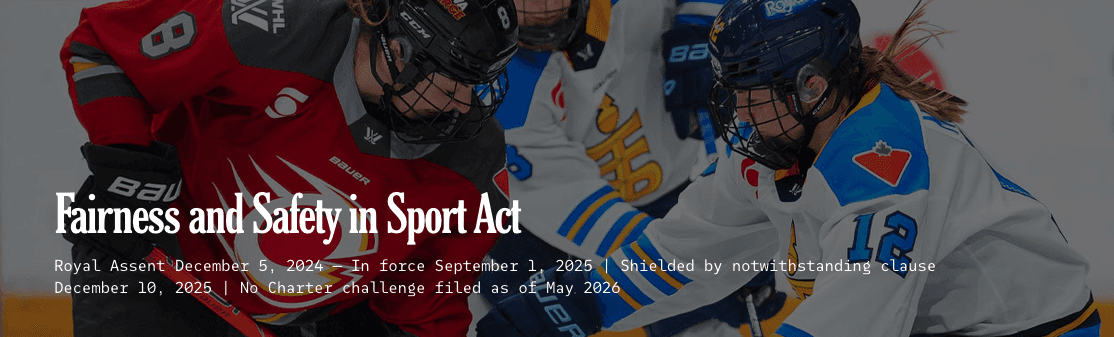
Alberta's Fairness and Safety in Sport Act, which came into force September 1, 2025, represents the first time any Canadian government has legislated biology-based eligibility for the female category in sport. Whatever one thinks of the specific mechanism Alberta chose, the principle it reflects — that female sport eligibility belongs in statute rather than administrative guidance — is correct. Parliament should have done this at the federal level before any province needed to.
Conclusion: The Act That Forgot to Define Women's Sport
The Physical Activity and Sport Act commits the Government of Canada to "the full and fair participation of all persons in sport." It does not define what fair means for female athletes. It does not define who is female for competitive purposes. It does not require that the female category be maintained on a biology-based standard. It has not been amended since 2017 to address the consequences of adding "gender identity or expression" to Canadian human rights law.
The women who compete in Canadian sport — who train for years to compete at national and international levels in a category designed specifically for biological females — are protected by a federal statute that does not mention them. Their competitive opportunities depend on administrative decisions made by Sport Canada and individual national sport organizations, without any legislative foundation requiring that those decisions reflect biological reality.
Parliament can fix this. The Physical Activity and Sport Act can be amended. The female category in Canadian sport can be defined in statute, grounded in science, and protected as a condition of federal funding. The question is whether Parliament has the political will to do what the evidence requires and what female athletes deserve: legislation that actually says what women's sport is for.
Key Provisions
Section 3: Physical activity policy objectives include promoting activity as fundamental to health and reducing barriers for all Canadians.
Section 4(1): Government of Canada's sport policy is founded on the highest ethical standards including "doping-free sport, the treatment of all persons with fairness and respect, the full and fair participation of all persons in sport."
Section 4(2): Sport policy objectives are to increase participation and support excellence in sport and to build capacity in the Canadian sport system.
Section 5: Objects are to encourage, promote, and develop physical activity and sport; Minister may take any measures considered appropriate.
Section 5(m): Minister may "facilitate the participation of under-represented groups in the Canadian sport system."
Section 9: Establishes the Sport Dispute Resolution Centre of Canada as an independent body to resolve sport disputes.
Critical Gap: The Act does not define "female" or "male," does not define "fairness" in sex-segregated competition, and has never been amended to address the tension between sex and gender identity in sport eligibility.
No Eligibility Mandate: The Act does not require or prohibit any specific eligibility standard for the female category in sport; those decisions are left entirely to Sport Canada administrative policy and national sport organizations.
Ministerial Chain of Custody:
The Physical Activity and Sport Act has a single ministerial chain running through the Minister responsible for sport — a role that has migrated across multiple departments and portfolio titles since the Act's passage in 2003.
Denis Coderre served as Secretary of State for Amateur Sport under Prime Minister Jean Chrétien and was one of the key figures in the development of the legislation that became the Physical Activity and Sport Act. The Act received Royal Assent on March 19, 2003, with Paul DeVillers serving as Secretary of State (Amateur Sport) at the time. The Act replaced the 1961 Fitness and Amateur Sport Act and was understood as a modernization. Neither Coderre nor DeVillers, nor any minister since, used the Act's passage as an occasion to define female eligibility in competitive sport.
The ministerial responsibility for sport has been held by a succession of officials across Canadian Heritage, Sport and Persons with Disabilities, and Health portfolios. The ministers who have held the sport portfolio since Bill C-16 created the definitional conflict in 2017 — and who have presided over the Physical Activity and Sport Act's silence on female eligibility without moving to amend it — include:
Carla Qualtrough served as Minister of Sport and Persons with Disabilities from 2015 to 2017, and again as Minister for Women and Gender Equality from 2019 to 2021. In her capacity overseeing sport, she presided over the Act in the immediate aftermath of Bill C-16's passage without initiating any amendment to define female eligibility. In 2024, she issued a Statement on Trans and Gender-Diverse Inclusion in Sport as a private member that took the position of inclusivity over sex-based eligibility protection.
Pascale St-Onge served as Minister of Sport and Physical Activity from 2022 to 2024. She was the minister of record when Aquatics Canada adopted the World Aquatics biology-based eligibility policy in 2022 and when Sport Canada's internal guidance acknowledged that such policies are likely not in conflict with the Canadian Human Rights Act. No amendment to the Physical Activity and Sport Act was introduced under her tenure.
The current Minister responsible for sport under the Carney government inherits an Act that has never been used to protect the female category in Canadian sport. The Act's enabling language — which authorizes the Minister to take any measures considered appropriate — is broad enough to require biology-based eligibility as a condition of Sport Canada funding. That authority has never been exercised for this purpose.
References:
Physical Activity and Sport Act, SC 2003, c 2: https://laws-lois.justice.gc.ca/eng/acts/p-13.4/FullText.html
Fitness and Amateur Sport Act, SC 1961, c 28 (repealed).
Bill C-16: An Act to amend the Canadian Human Rights Act and the Criminal Code, 1st Sess, 42nd Parl, 2017 (Royal Assent 19 June 2017): https://www.parl.ca/DocumentViewer/en/42-1/bill/c-16/royal-assent
Canadian Human Rights Act, RSC 1985, c H-6, s 3(1): https://laws-lois.justice.gc.ca/eng/acts/h-6/
Sport Canada, Question Period Note: Gender Equity and Transgender Inclusion in Sport (PCH-2022-QP-00200): https://search.open.canada.ca/qpnotes/record/pch,PCH-2022-QP-00200
Sport Canada, Question Period Note: Transgender Inclusion in Sport (PCH-2024-QP-00039): https://search.open.canada.ca/qpnotes/record/pch,PCH-2024-QP-00039
World Aquatics, Policy on Eligibility for the Men's and Women's Competition Categories (2022, updated 2023).
Future of Sport in Canada Commission, Interim Report, Chapter 5: Funding in the Sport System (2025): https://www.canada.ca/en/canadian-heritage/campaigns/future-sport/participate/interim-report/chapter-5.html
Government of Canada, Sport Policies, Acts and Regulations: https://www.canada.ca/en/canadian-heritage/services/sport-policies-acts-regulations.html
Bill 29, Fairness and Safety in Sport Act, Alberta, 2024 (in force September 1, 2025): https://www.alberta.ca/ensuring-fairness-safety-and-inclusivity-in-sport
Canadian Charter of Rights and Freedoms, Part I of the Constitution Act, 1982, s 15.
Canadian Centre for Ethics in Sport, Creating Inclusive Environments for Trans Participants in Canadian Sport (2016): https://www.cces.ca/sport-and-inclusion
Read More
text
Statistics Act
Federal law governing Statistics Canada's data collection; critically undermined for women's safety research since 2019, when Statistics Canada replaced biological sex with self-declared gender in crime reporting — making it impossible to accurately track male violence against women, including in federal prisons.
text
UN Bangkok Rules
United Nations Rules for the Treatment of Women Prisoners (Bangkok Rules) - international standard requiring gender-specific prison policies and recognizing women's distinct needs and vulnerabilities.