
Sport Canada Sport Support Program Funding Framework
Sport Canada administers hundreds of millions in annual federal funding to national sport organizations with five governance conditions required — but female sport category eligibility is not among them. The framework acknowledges biology-based policies are likely legal, then deploys public money with no standard for who competes in the female category.
Canadian Taxpayer Money With No Standards for Women's Sport
Every year, the Government of Canada transfers hundreds of millions of dollars to national sport organizations through Sport Canada's Sport Support Program. Those organizations use that money to develop athletes, fund competitions, hire coaches, and run programs across Canada. The athletes who benefit from Sport Canada funding compete in categories — men's and women's — that have historically been defined by biological sex.
Sport Canada has no official policy on who belongs in the women's category. It has never required, as a condition of the public funding it distributes, that any national sport organization maintain any particular standard for female eligibility.
And it has explicitly acknowledged, in internal documents obtained through Access to Information requests, that biology-based eligibility policies are almost certainly legal under the Canadian Human Rights Act — and then done nothing with that conclusion.
This is the story of a funding framework that deploys public money without demanding that public money be used to protect what it is ostensibly funding: women's sport.
What the Sport Support Program Is
The Sport Support Program (SSP) is the federal government's primary mechanism for funding national sport organizations. Administered through the Department of Canadian Heritage, it provides funding through several distinct components.
The National Sport Organization (NSO) component funds the single national governing body for each recognized sport in Canada. As of 2023-24, this was the largest component of the SSP by expenditure, supporting everything from technical programs and coach development to high-performance pathways and international competition.
The Athlete Assistance Program (AAP) provides funding directly to individual athletes nominated by their national sport organizations. In 2023-24, the AAP provided $33 million to more than 1,800 Canadian athletes to offset living, training, and education costs. Athletes must meet eligibility criteria set by their NSO — criteria that Sport Canada does not define and does not require to be sex-based.
The Hosting Program funds major domestic and international sporting events in Canada, including the Canada Games, the North American Indigenous Games, and international single sport events.
Additional components fund multisport service organizations, Canadian sport centres and institutes, community sport initiatives, and an independent safe sport mechanism.
In 2023-24, the Sport Support Program's total budget was $178.7 million. The Athlete Assistance Program added $33 million, and the Hosting Program added $20.9 million — for a combined annual federal sport investment of over $230 million. In April 2026, the federal government announced a major new investment: $660 million over five years to national sport organizations, with $110 million ongoing, following a Future of Sport in Canada Commission report that found the sport system in a widespread funding crisis.
What the Funding Requires
As of April 1, 2025, national sport organizations must meet five governance requirements as a condition of receiving Sport Support Program funding.
These requirements oblige funded organizations to maintain:
A diverse, well-trained board of directors with athlete representation and oversight committees
Discipline and appeal procedures that include dispute resolution through the Sport Dispute Resolution Centre of Canada
Adoption of the Canadian Safe Sport Program, which addresses maltreatment and misconduct in sport.
These are meaningful governance improvements. The safe sport requirement in particular emerged from years of documented abuse and maltreatment across Canadian national sport organizations.
But notice what is not on the list. There is no requirement that NSOs maintain any particular standard for who may compete in the female category. There is no requirement that eligibility decisions for the women's division be grounded in biological science. There is no requirement that female athletes have access to fair competition against biological peers as a condition of the federal funding that supports their sport.
The Aquatics Canada Precedent: Acknowledging the Law, Then Doing Nothing
In 2022, World Aquatics adopted a landmark eligibility policy for the female category. The policy, based on a thorough scientific review of the evidence on sex differences in aquatic performance, concluded that male physiological advantages in swimming are substantial and not eliminated by hormone therapy. Under the World Aquatics policy, athletes who have undergone any part of male puberty are ineligible to compete in the women's category at World Aquatics events.
Aquatics Canada, as the Canadian member federation, voted to adopt this policy for domestic competitions as well. This made Aquatics Canada one of the first Canadian national sport organizations to implement a biology-based eligibility standard for the female category.
When Aquatics Canada adopted this position, Sport Canada's internal guidance — subsequently obtained through Access to Information requests — stated explicitly that there was "no basis for considering whether the provision of funding by Sport Canada to Aquatics Canada, or any NSO supporting a similar gender policy, engages CHRA concerns." Sport Canada's own officials had assessed the question and concluded that biology-based eligibility policies are not in conflict with the Canadian Human Rights Act.
Sport Canada then did nothing.
It did not make biology-based eligibility a condition of SSP funding. It did not issue guidance to all national sport organizations encouraging or requiring them to adopt similar standards. It did not announce that the female category in federally funded sport would be protected as a biology-based category. It acknowledged that the law permits science-based female eligibility, confirmed that its own funding of organizations that maintain such standards is legally defensible, and then deployed hundreds of millions of dollars annually with no requirement that any of those dollars support a meaningful female category.
Sport Canada's "No Official Policy" Position
Sport Canada's stated position on transgender inclusion in sport is that it has no official policy. National sport organizations are "encouraged to find innovative, evidence-based solutions that afford respect to trans-identifying athletes, while preserving fairness and safety for sport and all athletes."
This formulation is instructive for what it reveals about Sport Canada's priorities. The onus in Sport Canada's guidance is on finding solutions that afford respect to transgender athletes. The protection of fairness and safety for female athletes is framed as a secondary consideration.
The science runs in exactly the opposite direction. The evidence base on sex differences in athletic performance is substantial and consistent: males who undergo male puberty develop physiological advantages in strength, speed, cardiovascular capacity, and other performance-relevant traits that are not reversed by hormone therapy. World Athletics, World Aquatics, World Rugby, and an increasing number of international sport federations have reviewed this evidence and concluded that biology-based eligibility standards are necessary to maintain meaningful female competition.
Sport Canada's guidance asks organizations to find solutions — as if the scientific question were still open and the policy question were primarily one of inclusion rather than fairness. It deploys no federal funding requirement to ensure that those solutions actually protect the competitive integrity of women's sport.
The Athlete Assistance Program Gap
The Athlete Assistance Program deserves particular attention. This program provides direct financial support to individual athletes — carding funding that offsets training, living, and education expenses. In 2023-24, AAP funding supported over 1,800 Canadian athletes at a total cost of $33 million.
Athletes receive AAP funding after being nominated by their national sport organization. They must meet the eligibility criteria set by their NSO to receive nomination. Sport Canada does not define what those eligibility criteria must be, and in particular does not require that an athlete meet biology-based criteria to compete — and be nominated — in the female category.
This means that federal dollars flow directly to athletes nominated in the female category by organizations that may or may not use biology-based eligibility standards. A male athlete who is allowed by an NSO's self-identification policy to compete in the female category can be nominated in that category for AAP funding. Federal dollars designated for female athletes can go to athletes who are not biological females.
This is not a hypothetical risk. It is a structural feature of a funding framework that has no requirement that "female" mean biological female for purposes of the sport programs it funds.
The Canadian Centre for Ethics in Sport Problem
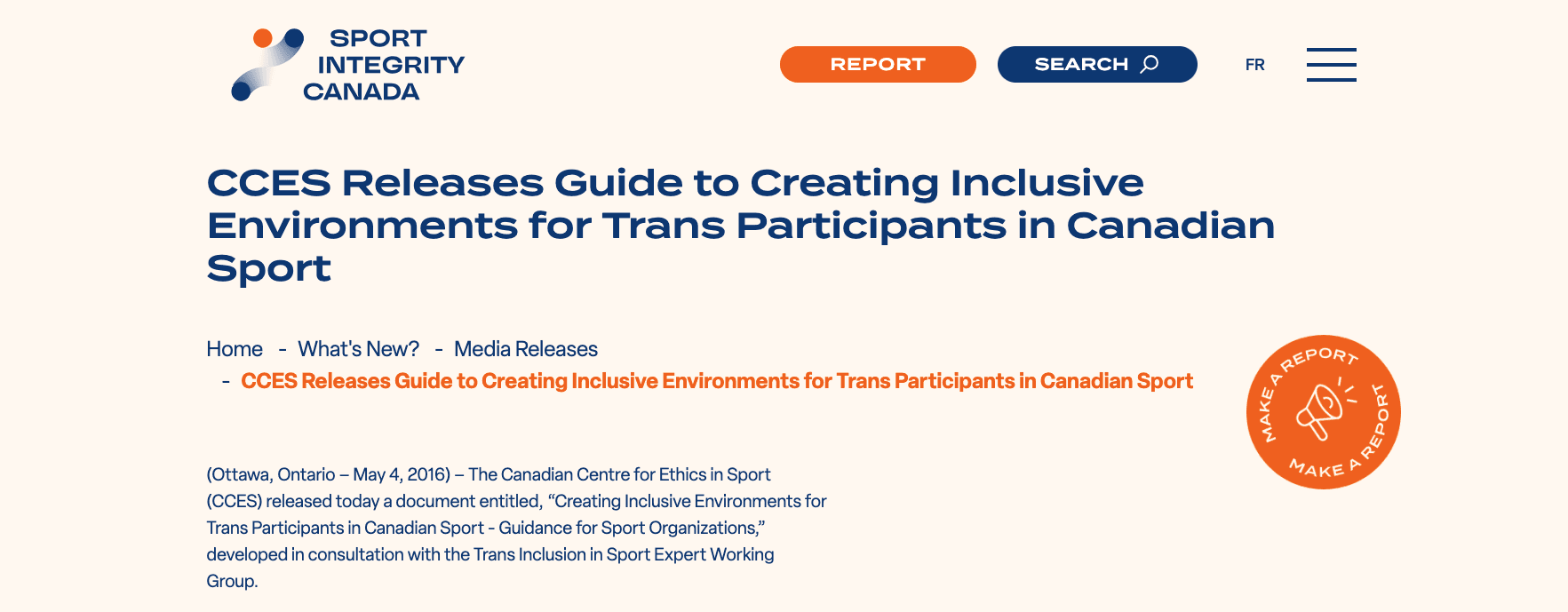
The Canadian Centre for Ethics in Sport (CCES) is a national multisport service organization that receives Sport Support Program funding. In 2016, the CCES published guidance encouraging full inclusion of transgender athletes in the female category based on gender self-identification — without any requirement for medical transition or testosterone reduction.
Sport Canada acknowledged, in its internal guidance, that it had not endorsed this CCES policy and that adoption of it is not a condition of funding. But the CCES, which develops that guidance and distributes it to national sport organizations across Canada, continues to receive federal funding. The federal government funds an organization whose transgender inclusion guidance goes further toward self-identification than Sport Canada's own position — and then declines to correct either the guidance or the funding relationship.
This is not neutrality. It is a choice to fund policy development that erodes the female category in Canadian sport, while officially disclaiming responsibility for the results.
The Hosting Program and International Events
The Hosting Program funds Canada's ability to host major international sport events. When World Athletics or World Aquatics events are held in Canada, athletes who compete must meet those federations' eligibility requirements. For sports that have adopted biology-based eligibility standards for the female category, those standards apply in Canadian-hosted events regardless of what any Canadian NSO policy says.
But for events governed by organizations that have not adopted biology-based standards — or where self-identification remains the operative criterion — the Hosting Program funds events in Canada where the female category may include athletes who are not biological females.
The federal government has never made biology-based eligibility a prerequisite for hosting international events in Canada. It funds the hosting of events where the female category is defined by the international federation's own standards — which, across the landscape of international sport, vary considerably.
The $660 Million Announcement and What It Changes
In April 2026, following the Future of Sport in Canada Commission's final report, the federal government announced $660 million over five years — and $110 million ongoing — in new core funding for national sport organizations. This was a generational investment that national sport organizations had sought for years, arguing that core funding had not increased in more than two decades and that the real value of federal support had declined by a third due to inflation.
The April 2026 announcement was accompanied by language about accountability and reform. The government stated that it expects national sport organizations to work with private sector partners, make changes to programming, and invest in sport at all levels.
None of the reporting on this announcement included any requirement that the new funding come with a biology-based eligibility standard for the female category. The new money flows into the same framework as the old money: abundant federal support for national sport organizations, with no requirement that those organizations protect the competitive integrity of women's sport as a condition of receiving that support.
What Responsible Funding Conditions Would Look Like
The Sport Canada funding framework already requires five governance conditions as a condition of receiving Sport Support Program funding. Adding female eligibility protection to that list would be administratively straightforward and legally defensible.
Sport Canada has already concluded that biology-based eligibility policies are consistent with the Canadian Human Rights Act. The legal groundwork has been done. What is missing is the political will to convert that legal conclusion into a funding requirement.
A responsible funding condition for female sport eligibility would require that national sport organizations receiving federal funding maintain eligibility standards for the female competitive category that are grounded in biological sex — specifically, in whether an athlete has undergone male puberty — and that those standards be reviewed periodically against the scientific evidence from international sport federations and peer-reviewed research.
This approach would not require NSOs to exclude transgender athletes from sport. It would require them to maintain a biology-based female category, which is consistent with what the majority of international sport federations are moving toward. Transgender athletes could compete in the male/open category, in emerging open categories, or in other formats that accommodate them without redefining the female category in ways that undermine its competitive integrity.
The Democratic Accountability Gap
The Sport Canada funding framework is an administrative program. It is not legislation. The conditions attached to federal sport funding are set by ministerial policy, not by Parliament. They can be changed by a minister without any parliamentary debate or vote.
This means that the protection of female sport eligibility — or its absence — is a ministerial decision. The ministers who have administered the Sport Support Program since 2017 have chosen, year after year, not to add female eligibility protection to the funding conditions. They have done so despite Sport Canada's own acknowledgment that such conditions would be legally defensible. They have done so while deploying hundreds of millions of dollars annually in federal funding that flows to sport organizations with no requirement that those organizations define women's sport on a biology-based basis.
That choice is accountable. Each minister who signs the Sport Support Program guidelines is the person who decided not to protect women's sport. Each minister who approved the Athlete Assistance Program nominations is the person who decided not to require biology-based eligibility as a condition of female carding. The accountability is clear — and it belongs to the officials who made the choice, year after year, to fund sport without requiring that sport's foundational category mean what female athletes need it to mean.
Conclusion: Hundreds of Millions of Dollars, No Standards for Women's Sport
The Sport Canada funding framework represents one of the most significant levers available to the federal government over the Canadian sport system. Hundreds of millions of dollars annually flow to national sport organizations as a result of that framework. Those organizations set eligibility standards, run competitions, and develop the athletes who represent Canada on the world stage.
Sport Canada has no official policy on who may compete in the female category. It has acknowledged that biology-based eligibility policies are legally defensible. It has declined to require them. It funds organizations that use biology-based standards and organizations that use self-identification standards, with no preference between the two.
Female athletes who have spent years preparing to compete in a meaningful female category are left to hope that their NSO has chosen a policy that protects the competitive integrity of their sport. Some have. Many have not. The federal government, which funds all of them, has decided that this question is not one on which federal funding conditions should take a position.
That is not neutrality. It is a decision to leave female athletes unprotected by the public money deployed in their name.
Key Provisions
Sport Support Program (SSP): The primary vehicle for Sport Canada funding; administered through the Department of Canadian Heritage; includes components for National Sport Organizations, National Multisport Services Organizations, Canadian Sport Centres, and community initiatives.
Athlete Assistance Program (AAP): Funds individual athletes directly, nominated by their national sport organizations; athletes must meet eligibility criteria set by their NSO — criteria Sport Canada does not define.
Hosting Program: Funds major domestic and international sporting events in Canada, including international single sport events and Canada Games.
Five Governance Conditions (as of April 1, 2025):
NSOs must maintain a diverse, well-trained board of directors with athlete representation
Oversight committees
Dispute resolution procedures including through the Sport Dispute Resolution Centre of Canada
Adoption of the Canadian Safe Sport Program
Compliance with other program requirements. Female sport category eligibility is not a condition.
No Female Eligibility Condition: Sport Canada has no official policy on transgender inclusion in sport; adoption of any specific eligibility framework is not a condition of NSO funding; organizations are "encouraged to find innovative, evidence-based solutions."
Budget: Sport Support Program total was $178.7 million in 2023-24; Athlete Assistance Program was $33 million; Hosting Program was $20.9 million. Major new investment of $660 million over five years announced April 2026.
CHRA Acknowledged as Not Requiring Inclusion: Sport Canada's own internal guidance explicitly states there is "no basis for considering whether the provision of funding by Sport Canada to Aquatics Canada, or any NSO supporting a similar gender policy, engages CHRA concerns" — then declined to act on this conclusion.
Ministerial Chain of Custody:
The Sport Canada funding framework has a ministerial chain that runs through the Minister responsible for sport — a portfolio held under various departmental titles including Canadian Heritage, Sport and Persons with Disabilities, and Health.
Carla Qualtrough served as Minister of Sport and Persons with Disabilities from November 2015 to January 2017 and then in other portfolios through the Trudeau government. During her tenure as sport minister, the Sport Support Program guidelines were in place with no female eligibility condition. She later issued a 2024 Statement on Trans and Gender-Diverse Inclusion in Sport that took a pro-inclusion position — a statement that some advocates called on the government to adopt as formal Sport Canada policy.
Kent Hehr served briefly as Minister of Sport and Persons with Disabilities from January 2017 to January 2018 during the critical period when Bill C-16 was enacted and the implications for sport eligibility first became apparent. No amendment to SSP conditions was made under his tenure.
Kirsty Duncan served as Minister of Sport and Persons with Disabilities from 2018 to 2019. She was the minister when Sport Canada was developing its internal assessment of the CHRA and transgender sport eligibility — assessments that concluded biology-based policies are likely legally defensible — with no action taken to make such policies a condition of funding.
Pascale St-Onge served as Minister of Sport and Physical Activity from 2022 to 2024. She was minister of record when Aquatics Canada adopted the World Aquatics biology-based eligibility policy in 2022 and when Sport Canada's internal guidance explicitly acknowledged the policy was likely not in conflict with the CHRA. No amendment to SSP funding conditions was made under her tenure.
The current Minister of Sport under the Carney government administers a Sport Support Program that has just received its largest single funding increase in more than two decades — $660 million over five years announced in April 2026 — without any attached requirement that the female category in Canadian sport be maintained on a biology-based standard. The political accountability for that omission sits with the current minister and with every predecessor who declined to add female eligibility protection to the SSP conditions since 2017.
References:
Sport Canada, Sport Support Program — National Sport Organization Application Guidelines (November 2025): https://www.canada.ca/en/canadian-heritage/services/funding/sport-support/application-guidelines.html
Sport Canada, National Sport Organization — Sport Support Program: https://www.canada.ca/en/canadian-heritage/services/funding/sport-support/national-organization.html
Sport Canada, Sport Support Program: https://www.canada.ca/en/canadian-heritage/services/funding/sport-support.html
Sport Canada, Question Period Note: Gender Equity and Transgender Inclusion in Sport (PCH-2022-QP-00200): https://search.open.canada.ca/qpnotes/record/pch,PCH-2022-QP-00200
Sport Canada, Question Period Note: Transgender Inclusion in Sport (PCH-2024-QP-00039): https://search.open.canada.ca/qpnotes/record/pch,PCH-2024-QP-00039
Future of Sport in Canada Commission, Interim Report, Chapter 5: Funding in the Sport System (2025): https://www.canada.ca/en/canadian-heritage/campaigns/future-sport/participate/interim-report/chapter-5.html
Sport Canada, National Sport Organizations — 2024/2025 Funding: https://www.canada.ca/en/canadian-heritage/services/sport-organizations/national/funding.html
Physical Activity and Sport Act, SC 2003, c 2: https://laws-lois.justice.gc.ca/eng/acts/p-13.4/FullText.html
Canadian Human Rights Act, RSC 1985, c H-6: https://laws-lois.justice.gc.ca/eng/acts/h-6/
World Aquatics, Policy on Eligibility for the Men's and Women's Competition Categories (2022, updated 2023).
Government of Canada, Spring Economic Update 2026 — Sport Funding Announcement: https://www.cbc.ca/sports/government-budget-update-2026-sports-funding-9.7180540
Canadian Centre for Ethics in Sport, Creating Inclusive Environments for Trans Participants in Canadian Sport (2016): https://sportintegrity.ca/news/cces-releases-guide-creating-inclusive-environments-trans-participants-canadian-sport
Sport Canada, Question Period Note: Sport Support Program Budget (PCH-2024-QP-00045): https://search.open.canada.ca/qpnotes/record/pch,PCH-2024-QP-00045
Read More

text
Privacy Act
Canada's federal criminal law, amended by Bill C-16 in 2017 to add "gender identity or expression" to hate speech and sentencing provisions — creating a legal environment in which women who publicly advocate for sex-based rights risk being accused of promoting hatred, producing a chilling effect on legitimate advocacy.
text
Statistics Act
Federal law governing Statistics Canada's data collection; critically undermined for women's safety research since 2019, when Statistics Canada replaced biological sex with self-declared gender in crime reporting — making it impossible to accurately track male violence against women, including in federal prisons.